Yup. ChatGPT did not have proper MCP support until now. They only supported MCP for connecting Deep Research to additional data sources, and for that, your MCP server had to implement two specific tools that Deep Research is able to call.
What’s being released here is really just proper MCP support in ChatGPT (like Claude has had for ages now) though their instructions regarding needing to specific about which tools to use make me wonder how effective it will be compared to Claude. I assume it’s hidden behind “Developer Mode” to discourage the average ChatGPT user from using it given the risks around giving an LLM read/write access to potentially sensitive data.
I find it odd you included potatoes in the list of foods to give up. Boiled potatoes in particular rank at the very top of the satiety index[1], meaning they keep you full longer with less calories than other food (likely due to a combo of high water and fiber content.) I recently lost a modest 10 lbs and mashed potatoes (even with some added butter and milk) were a staple of my diet—keeping me from feeling hungry even at a calorie deficit.
This hits the nail on the head. Abandoning time zones would only make sense if there were no more need for time translation. But you'd still need to translate for the sake of biological clocks, and without time zones it would become more challenging to communicate that translation.
I would be in favor of doing away with DST and also eschewing AM/PM in favor of a 24-hour clock. I'm surprised this article didn't mention that.
Yeah agree completely. And keeping zones is important to understand workdays. I wouldn't mind dropping named time zones completely in favor of UTC+Offset, I always end up looking that up, annoyingly.
Or just name the zones based on the offset. So NY would be -5. We could for humans write time with the ecoding, similar to ISO-8601, but it would just be 15:30-5 for 3:30pm EST.
While we're at it. Can we make all the months standard lengths too? 30 day months, with 1 New Year's Day (for a fun party) and every four years a bonus New Year's Day! For an especially big party :)
Edit: as stated below I screwed up my (basic) math. 13 months 28 days is better. What should we call the 13th month?
Your math doesn't work out there though. If we had 30 day months, we would end up with 360 days spread among 12 months, and an extra 5 days leftover.
28 day months make far more sense, would align nicely with your proposed single New Year's day, and have the added bonus of aligning with our 7-day week system quite nicely. This ends up with 13 months altogether, and hey, it turns out that 28 days is closer to a lunar cycle, so the full moon would end up happening at roughly the same time every month. Not perfectly of course, but with the chaos that is our solar system, I'll take what I can get.
https://en.wikipedia.org/wiki/International_Fixed_Calendar
That first example (12 30 day months with 5 or 6 days outside months) was actually used in practice in post-revolutionary France (and again during the Paris Commune). I'm not sure keeping 7-day weeks is really a plus -- the French Revolutionary calendar used 10-day "decades" which align with the metric system.
https://en.wikipedia.org/wiki/French_Republican_Calendar
I will just point out for the benefit of those who run Emacs and haven't yet discovered it, that in calendar mode, "p f" will tell you, for example, that November 7, 2016 is 17 Brumaire, year 225 of the revolution.
But you do.. Sort of. One of the original signatories of the treaty of the metre, and all of your silly units for length and mass at least are defined in terms of SI units as of 1959 [1] [2].
So when you give someone an inch, you're specifically giving 25.4mm ;)
And yeah. I mean 10 is only divisible by 2 and 5 where 12 is much more flexible in giving us 2, 3, 4, and 6. At least that was my grandfather's argument.
I annoying need to keep Metric and Standard wrenches and such for working on various things. Eventually it won't matter as the US will mostly source parts built over-seas where it will only make sense to adopt metric. And then the Standard system will only be left on road signs and temeratures, oh that's pretty much already happened.
Like something that is not going to happen. Religious days are the reason we have weekends where they are. They are not going to change because "why not have 4 day weeks".
Religious groups may stay with their own calendar if they wish, it wouldn't be the first nor the last thing kept conservative out of religious reasons. The secular society, however, may look for whatever works best.
I was shocked, being a visitor here, when sometime about a month ago, we celebrated new year (after the 13th month), while the rest of the world was in the middle of the Gregorian calendar!
28 is perfect because it's divisible by 7. So every day lands on the same day of every month and every year. Every 1rst is a Sunday.
But really, while we are on the topic of reform, is there any particular reason the week should be 7 days? Or that there should be a week at all?
Time keeping is also weird. Base 24 and 60 is so arbitrary. Make it base ten, and you can express date and time easily. Right now is 6.976. The 9 is the hour, the 76 is the minute, etc.
And then if we are talking about radical standards reform, let's do away with base 10 entirely and go to 12. It carries more precision in less space, is much more divisible, and has more patterns in the multiplication tables.
I love thinking about how more optimal the world could be if not for coordination problems and other issues.
ISO, and many places, yes, but not everywhere. Is it necessary to add "At least in the civilized world"? Seems unnecessarily inflammatory. And the gp is proposing a new system anyway.
The point was that the proposal is based on assumptions that don't hold true in ever culture, but would be forced onto those cultures if it were implemented. This is of course true for most, if not all, proposals for changing the way we handle time.
According to Wikipedia there are at least three "first day of the week" in use, sorted by (my assumption of) affected population:
Monday: EU and most of other European countries, most of Asia and Oceania
Sunday: Canada, USA, Korea, Japan, Israel, South Africa, most of Latin America
Wikipedia says the first day of the week in New Zealand is Monday, but our calendars usually start on Sunday and personally at least, I've always thought of Sunday as the first day of the week. So I'm not sure I'd trust that page too well.
It's really not important at all... The point is this calendar would line up the week cycle with the month cycle, which has a ton of advantages. You can't throw that away just because you can't agree what day of the week should come first.
Hell, while we are at it we can just rename the days firstday, secondday, etc, and not have to deal with that issue.
You want to switch time to base 10 and everything else to base 12 even though you consider it to be arbitrary?
We use 12, 60 (and 360deg) because our fingers are divided into 12 sections on the palm side.
You can use your thumb to point to each section on your right hand, counting to 12, while using the number of fingers on your left hand to keep track of how many 12s (up to 5) hence base 60.
This sounds interesting, but I'm skeptical. 12, 60, and 360 have nice mathematical properties independent of human morphology. Do you have references to cite this?
Your radical time standard reform undoes your first change - it's already based on the number 12, remember? 24 is two 12-hour periods - A.M. and P.M. and 60 minutes/seconds is 12 five-minute/second periods (the numbers on a clock).
It's based on 24, which is divisible by 12. But that's not quite the same as having a clock that is based on the base you use. A base 12 clock would work just like a decimal clock, just with 2 extra symbols. It would not look like the base 24 clock with base 60 minutes and base 60 seconds.
Having 7-days week concept is not necessary. That 28 days being divisible by 7 can be used to create a smaller group of days that we currently use for week. I presume that in such a 4-days group the ratio of 3 days for work and 1 for leisure should both increase the efficiency and to thin out the work stress.
Having Sunday as the first day would mess up our week, because we call Tuesday, Thursday and Friday second, fourth and fifth respectively. If you really want 1st each month to be first day of week, either America will have to adopt Monday as first, or vary the day of week by region.
Wednesday is called "Mittwoch" in German, which is a shortened form of "middle of the week". Only works if Sunday is the first day of the week, though the common convention is also having the week start on Monday. Confused me quite a bit as a child :)
When I was a kid, I toyed with the idea of metric time. I realized it wouldn't work when I thought about TV shows - a 30 minute show would need to be condensed into 2 14.4 minute centi-days. That would require losing 1.2 minutes of commercials, never gonna happen.
A half hour in decimal time (half a deciday), would be 72 minutes normal time. A quarter decimal hour/deciday would be 36 normal minutes, which is pretty close and gives even more time for ads.
You could also split time further into thirds, which would work even better with a base 12 system.
I assumed you'd be breaking the units into tenths all the way down, not quarters as you advocate here. Would certainly solve the problem though, maybe even too well.
The units are based on 10, but nothing stops people from dividing it further. Just as someone might use a unit of "half a kilometer" or "half a liter", which are other base 10 units.
After giving this some more thought, I realize you're right. We already deal with programs starting on xx:30, now we'd just get used to things starting at x.25, x.50, and x.75. Instead of running from 8:00 to 8:30 PM, a show might run from 8.00 to 8.25.
6 minutes is too much time though, if you tried to fill that with ads you'd lose your audience fast.
Dividing into thirds doesn't really work in a decimal system.
A 7 day work week seems to be optimal for most. Specifically, the 5 days on / 2 off. Apparently, medical staff working 10 / 4 have issues, and attempts at running e.g. 7/3 also don't go over very well.
The 40-hour workweek is a direct function of (1) that it's advantageous to have the fewest employees possible, because each additional employee has overhead costs; (2) you can't make employees work more than 8 hours/day (a number that was arrived at through significant strife and is unlikely to change substantially); (3) everyone gets two days off in a 7-day period.
The 40-hour workweek isn't an arbitrary quantity, it's an empirically derived quantity. And the process of deriving it literally involved people killing each other. I don't see it changing very soon, except in edge cases.
Yes. Perfect. I've never seen that before. Thanks for sharing. It will never sell in the US though, the mere inclusion of Darwin will make it a political nightmare as people would be convinced we're atheists trying to kill their god.
Or, we use Latin names of numbers. So, Unusber, Duober, Tresber, Quattorber, Quinber, Sexber [rename as necessary for America], September, October, November, December, Undecimber, Duodecimber, Tredecimber.
These would be better names from a purely phonological point of view: Unusper, Tresper, Quattober, Sexper. That way you don't have awkward clusters of both voiced and unvoiced consonants. The -ber affix having originally come from mensris (-mens-ris > *-membris > -ber), devoicing the initial 'b' to 'p' in those circumstances is reasonable enough. 'Quattober' is a simplification that makes it fit the pattern better.
Alternatively, you would rely on the ordinals, dropping the -us ending and replacing it with -ilis as in Sextilis and Quintilis.
Introduce it as a means to purge the name of non-Christian gods from their current months and days, and suggest any opponents can't be monotheists after all given that they give other deities such a prominent position in their lives.
I believe this "new calendar" idea has already been tried several times. Religion and agriculture always seem to be the sticking points.
Months are hardly necessary, anyway. Wouldn't quarters be better?
Have 4 quarters of 13 * 7-day weeks each. Designate the vernal equinox as day 0 of the calendar, follow it with the 4 91-day quarters, and tack on leap days after the 4th quarter according to the Gregorian calendar rules.
So you end up with dates like the 41st of Spring, or the 82nd of Summer. New Year's Day would be the 0th (nilth) of Spring, and Leap Day the 92nd of Winter.
"Months are hardly necessary, anyway. Wouldn't quarters be better?"
Months are, more or less, related to the moon periods, just like the year is to earth period. And most of the world has year quarters, called seasons. Seasons are there (in front of our eyes) to stay, regardless of how we'll choose to distribute the days of the year.
Workdays are not worth keeping either. With the gig economy, you can't know if someone works at night or during the day, or morning or Sundays or whatever.
I vote a 256 day year, of 8 , 16 day months. Each month is 4, 4 day weeks, with odd weeks being mandatory global time off. New years is a one bMonth long global celebration, also time off.
This has a beneficial side effect of making date handling easier for 8 bit microcontrollers, so when the singularity happens, the superAI will take pity on us because we showed mercy to its ancestors.
> This hits the nail on the head. Abandoning time zones would only make sense if there were no more need for time translation. But you'd still need to translate for the sake of biological clocks, and without time zones it would become more challenging to communicate that translation.
I argue it'd avoid mistakes, such as the assumption it's dark at the other clock's 18h because it is here.
I get the impression Americans don't use 24-hour clock much. In Europe it's pretty much standard if you want to communicate time reliably. Or am I mistaken about the American love of am/pm?
Your impression is pretty much spot on. We have "military-time" and "24-hour time" available to us in all of our application configurations, but no-one seems to use it. I do because it helps me do time-zone translating transforms to/from UTC in my head more easily, but also because I keep failing to see that little "PM dot" or set the "PM Flag" whenever dealing with times in various applications or alarms. Verbally, speaking with USians, 15.00 is always pronounced "3pm".
"Verbally, speaking with USians, 15.00 is always pronounced "3pm"."
It's like that everywhere in Europe. Nobody says 'see you at fifteen'. 24 hour clock is merely for writing things down. I mean it would already be an improvement if the US would catch up with that, just saying that a 24 hour clock isn't said out loud as such. (not disagreeing or anything with you I guess, just adding some information).
OK, it might be a social construct. I'd never say 'treize heures' to set a time with my Parisian colleagues, and neither would they (to the best of my recollection). Sometimes people would say it, yes, but it'd sound strangely artificial, like read literally from a schedule - which in many cases it would be.
In Quebec, 24 hour time has changed from being a nerd thing, to being the standard way of saying time. That's how the media pronounces time, how people write it down, etc. As others have mentioned, cell phones probably have something to do with that too.
I have the feeling that it is fairly recent. When I was a kid, I think that nobody used it regularly, then it started to be used on the radio and TV, and then, when I came back home after having spent 8 years abroad, I was surprised to hear it used by the average citizen.
I am not fond of it. It is heavy and in most use cases, doesn't bring more information than 1-12, because the context makes generally obvious to know if we're talking about AM or PM.
Okay okay I get it - you're all gently breaking it to me that I'm now officially old. I, too, used to be with it, but then they changed what it was. Now what I'm with isn't it, and what's it seems weird and scary to me, and it'll happen to you, too.
It's uncommon in personal settings, though, at least in German. If you call your doctor to make an appointment, they might ask you if "fifteen thirty" suits you, but when fixing a time for meeting your friends at a café you'd say "halb vier" (half four, which is 15:30 in Germany, but 16:30 in the UK. Yay confusion!)
Actually, "Halb vier" (half four) can mean both in Germany, depending on which village you are in. It becomes even more confusing if you use something like "Viertel vier", which, depending on your village, can mean 15:15, 15:45 or 16:15.
This is why the less rural people over here use exact time.
Citation needed! I've never heard anyone use the "half past" meaning. The quarter thing is confusing, though. While I have never heard of anyone parsing "viertel vier" as 15:45 or 16:15, many people are confused as it's somewhat uncommon here.
Not sure why you feel the need to imply people using "half" are somehow impaired (as the attribute "rural" is often used to imply backwardness). The "half" notation is ubiquitous in the south.
Let's meet at 15 o'clock" or "When do you go for lunch?" "thirteen-thirty" is totally daily usage in some places/groups (possibly age-related, since digital clocks here are always 24h and younger generations had more relative exposure to them)
While it is not uncommon to say "at three" instead of "at fifteen" in German, this only ever happens when context sufficiently avoids ambiguity. The language does not even know a generic qualifier for 12-based times (like am/pm), you would have to use the correct time of day name (non/afternoon/evening) for disambiguation. Much easier (and therefore much more common) to say "fifteen" instead. (for the second half, first half can only be specified the complicated way)
American English is all about factions. The use of 24hour time gives the impression that the speaker has ties to the military, which is a rather high percentage of the US population. I've had several people correct my use of 24-hour time (ie 0945) as being "dramatic" and that 9:45am is more "friendly". I had one person comment after a talk I gave (lots of slides with timestamps) that they thought I was talking down to the many military and former military people in the room. But the slides were originally created for Canadian university students. I'd used them several times north of the boarder. There, nobody noticed the timestamps as anything other than functional.
Whatever you do, don't mention metric time in the US. The 10-hour days and 100-day months that we find so normal drives them insane.
You are joking, but the French revolutionaries really tried to introduce 10 hour days (with a different value of "hour" obviously) broken into 100 minutes each (again not our minute) along with their new calendar.
They did that to break the control of the church, to do away with sundays. I've run into a couple people who still support the concept. I know one ardent atheist who doesn't like that we name days after Norse gods. Similarly, when I lived in the middle east some chuckled at the concept of an Islamic nation using pagan names on calenders. They don't want a 10-hour day, but both want to break from the old dogma.
> They did that to break the control of the church, to do away with sundays.
That was just an added bonus for the democratically elected Parliament to accept it, but it wasn't the initial reason.
Decimal time had mostly been pushed by mathematicians (d'Alembert decades before the Revolution, Borda who was the real ), and much later Poincaré, while the most important proponents of the decimal calendar were Romme and Dupuis (very far from being an atheist! though not a fervent Catholic either indeed) and respected scientists such as Lagrange and Monge.
The first and foremost reason was doing away with old arbitrary customs associated with the monarchy and replacing them with standards grounded into more universal, less arbitrary references.
That's the only reason I support it, for my part, and I doubt anyone in France cares now about having weekdays named after Roman gods. Even at the time of the Revolution I believe these names would actually have been somewhat appealing, as classical culture was seen then as a model with which to replace the despised monarchy and religious oppression.
I do. Granted, I was in the military-I passively hate it when people call it 'military time' (passively meaning I mentally roll my eyes when someone says it), but I've been using it since middle school when I first even learned it was a thing. Mostly because it made sense right away.
Because there are only 12 major divisions on a clock. An analog clock, that is. It reads the same at 3am and 3pm. So from that pov it only makes sense to call it the same.
And the truth is that even when you live in a country where 24 hours notation is commonly used, like I do, you'll still more often say "5 in the afternoon", than 17 hours. The latter form is used in writing when you wish to sound more formal or when you really want to make sure there's no ambiguity. And not in the "army" style like 17 hundred, but you just say 17 or in written form 17h. All in all, it's just a matter of notation, once you're used to it sufficiently it translates to the clock face the same. Whether it's written as 13h or 1pm I visualise it exactly the same.
Sure, as a novelty. Who here has ever seen one like that in the wild? And yes, I think 24 is much harder to read, and not necessary either - in those situations where you don't know (when looking at a clock) whether it's 3am or 3pm, you have much bigger issues to worry about :)
My point was more in the second para, that 12 hour clocks aren't a platonic ideal, they are likely a result of practical demands. We make 12 hour dials rather than having them thrust upon us.
I love the idea of a 24 hour clock with 0000 at the bottom. Then the hour hand roughly follows the sun around all day, and a glance at the clock gives you the phase & time of day regardless of light cues or any other bits.
In the wild, not so much. But I have one in my home office---A nice one, purely mechanical (needs a key to wind it up). It's the second 24-hour clock I've had.
I find this comment unexpected, being Irish, as I would've associated the attachment to 12 hour intervals much more with here than with the US. But I guess it's a British colonial throwback thing; I'd be curious to hear of au/nz/ca/za/in/etc. habits.
Outside of Quebec, the 12 hour clock is the majority but a significant minority use the 24 hour clock. Everyone understands the 24 hour clock in my experience though.
Unlike most of the imperial system, farenheit, etc, Am/pm seems to actually make some sense with analog clocks/watches. In places where you primarily use 24 hour time I guess you're always just translating from the clock in your head?
I suppose having grown up with 24-hour digital clocks since they first appeared in the 1970s, and most of the clocks around the house and on various devices being 24-hour digital, and using public transport which operates in 24-hour time, there is no "translation" that occurs, most Europeans are simply bilingual in 12/24 hour times.
1745 to me just means what 5:45pm means to you, but I never translate it in my head. In fact, if I'm texting someone older who I think might not naturally use 24-hour time, I have to translate to 12-hour time and it always feels odd to write the am/pm suffix.
Or you just have a secondary dial. The watch I'm wearing right now has a major 1-12 dial and a secondary 13-24 dial. But my other watch has a 1-12 dial and a secondary 1-24 dial, with a funky secondary hour hand, so perhaps I'm weird:-)
But the current concept of time is also based on the outdated industrial age concept of a 'working day' being 9-5.
I doubt many of the people on HN for instance, work those set hours in this day and age. Nowadays it is purely a convenience factor to keep the worker drones in the same hive so they can gather for the next interminable meeting.
With the rise of remote working, and other forms of communication tools, no one has to be constrained by those arbitrary work hours any more. I personally do my best work late at night and well into the early hours, and have indeed had remote meetings with overseas team members at 10 or 11 pm my time because it actually suits me better than 3pm my time, which is when I usually try and sleep off my post lunch lethargy. (Note: I see the irony in 'post lunch' - The concept of 3 set meals a day is also another byproduct of the agricultural/industrial age that is not really as relevant in modern society where families tend not to dine together at a set time any longer).
For those who live in our Ivory Tower of the software industry that may be true, but the 9-5 concept is not outdated for a vast majority of working humans on the planet. Lets not project our reality onto the rest of the world.
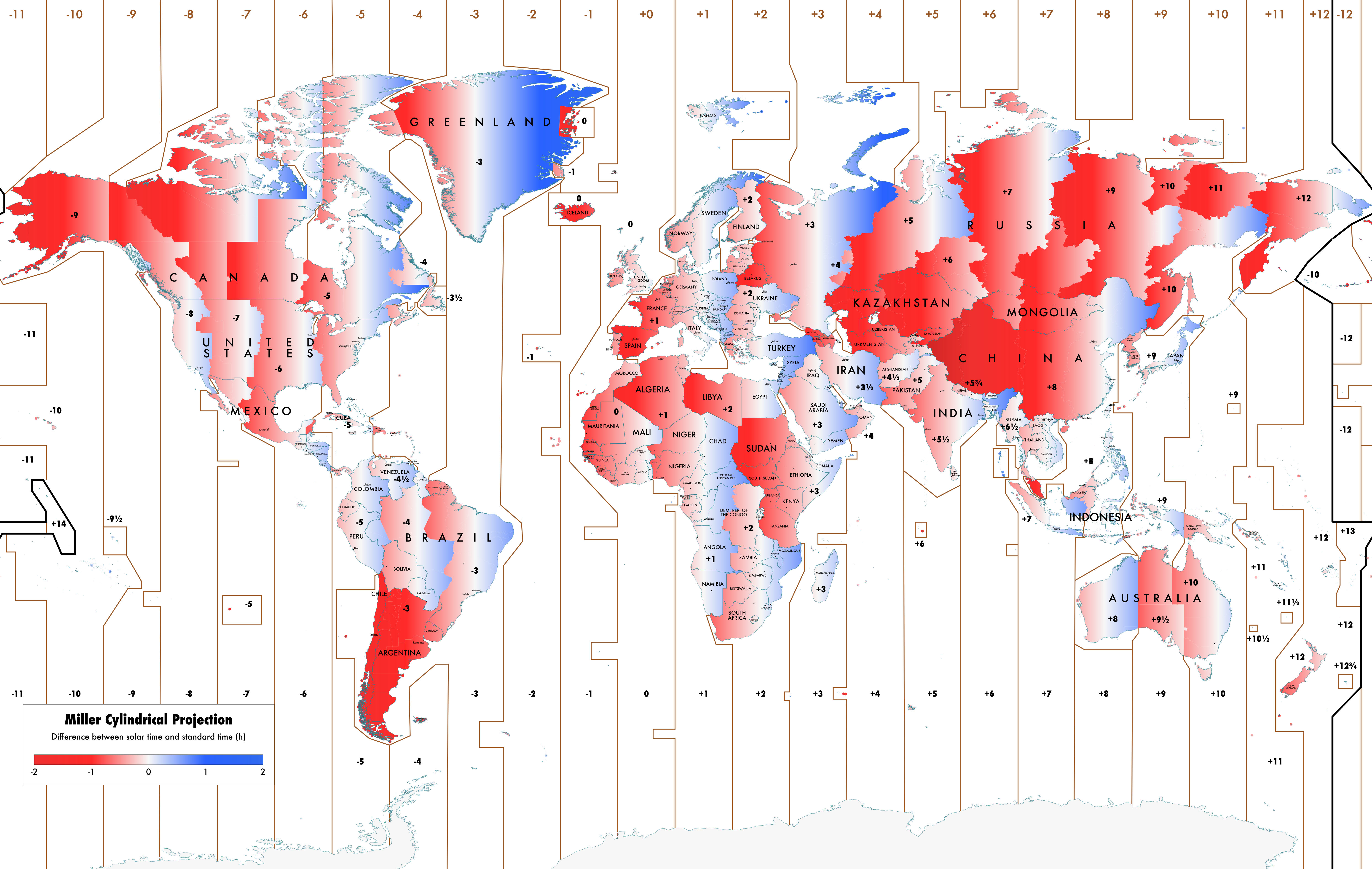
Japan adopted the 9-5. But Japan is on solar time, and thus the sun comes up at 4 AM during the summer in Tokyo. Japan also doesn't do DST. So 9-5 is actually 11-7 in "equivalent sunlight"
The idea of time zones is to keep people in sync, but most of the world is not even on a "12PM=Solar Midday" schedule! So when the sun comes up at 4, if feels weird, because it doesn't match what you see elsewhere on the same longitude.
If I understood correctly, Akashi is the "standard" (as in, fixed from Greenwich) reference in Japan, some 270 miles west of Tokyo, that means that the Sun is at the highest point just some minutes before 12 in Tokyo, which is not significantly different from what happens in London when the DST is not active? England sees the highest Sun at around 1 pm when the DST is active, but that's only one hour, give or take the minutes of seasonal variations from the real solar time, and that really only when DST is active, and Japan, as you say, doesn't do DST, and has the similar seasonal variations.
Therefore I don't understand your "11-7" equivalence.
I think his error is in assuming that the zenith should correspond to the midway point of your workday. Which is entirely not true: Our society is organized around getting to work first thing in the morning, and having some sunlight left after work hours for social activities.
So Tokyo is set to a 9-5, but if they want to follow the same strategy of getting to work first thing in the morning, then they should be doing 7-3, or even a bit earlier due to DST non-observance.
Main point is that 9 AM means vastly different things, even counting for longitude. Standard time has become standard, in setting when people wake up, but it's far from the locally ideal situations.
As the picture shows, Spain and the parts of France are the extremes in the Europe, in the rest of Europe the Sun is closer to being at 12:00 (not counting DST) not too different to Tokyo.
Yes, the map you link shows is that some parts of the world have wider time zones than it would allow all the people living there to have the Sun very close to 12:00. But your "Tokyo sunrise" argument is still not a good one. All the areas (and cities) in the map that are "relatively white" have Sun at the highest point around 12:00 noon. Tokyo is "relatively white." New York and LA are also "relatively white." So I still don't know what is your perspective for Tokyo being strange. Can you please explain? The dramatic example would in fact be Spain or even Argentina.
I see even bigger error in his argument based on when "the Sun comes up" since it's dependent on the latitude even in the same time zone. He should ask somebody living close to the North pole.
When I lived in London the seasonal variation in sunrise was just one of those things you lived with.
Everyone gets wrenched by the start and end of BST, but generally if someone says "5pm" or "17:00" you get a seasonal sense of how much daylight that implies. I can't imagine the US - or anywhere else - being different, except possibly close to the poles.
Absolute sun position matters a lot less than the felt relationship between clock time and sun position. That sense changes slowly but reliably over the year.
The obvious benefit of time zones is that virtually everyone you interact with daily has the same subjective time sense. Everyone knows that midday is going to be bright, midnight is going to be dark, and the rest is going to vary with the season.
I've thought occasionally about a clock standard that has 0800 be sunrise every day, and run the rest of the clock until whatever time necessary to reach the next day's 0800 point... unworkable for blatant reasons but it would do away with the dissonance of waking up in darkness or post-twilight morning depending on seasons.
Yeah, I grew up in Oslo, Norway, and found his idea that the sun rising around 4am in summer was something unusual very strange. To me, sunrise occurring well before I wanted to wake up in summer was the norm.
But then we also have far longer periods of sunlight during the summer.
What's annoying me even now in London is that sunset still comes too early during the summer (during the winter, on the other hand, I definitively appreciate the longer days here vs. Norway)
the 9-5 concept is not outdated for a vast majority of working humans on the planet. Lets not project our reality onto the rest of the world.
On the contrary, the 9-5 concept has never applied to the vast majority of working humans on the planet (agriculture, health, factories, sales, even most offices don't keep those hours). With growing communication across time zones, their difficulties have only recently become more obvious, previously this sort of communication was rare, now it is becoming commonplace.
The solution to not being sure if someone is working at a given hour is to schedule a call, preferably using a sane shared timekeeping standard which doesn't change hours at the whim of politicians.
> the 9-5 concept has never applied to the vast majority of working humans on the planet (agriculture, health, factories, sales, even most offices don't keep those hours)
Also, reproductive work (nursing children, taking care of the sick and elderly, cleaning the house).
So far you have the most levelheaded comment I've seen (out of 4... not a big sample size), but just wanted to agree.
We all need to get off our high horse and be more specific, at the risk of smaller readership. For global teams that are making software, GMT / 24 hour clocks are great. But lets not project our reality onto the rest of the world. I love that comment!
The opposite is also true - don't imagine a 1930's production line factory or bank clerk as the reality of a majority employee population working day.
Farmers, truck drivers, pilots, bakers, hospitality workers, nurses, street sweepers, security guards and a thousand other jobs are NOT bound to a 9-5 working time. Indeed, outside of government or large corporations, I struggle to find many professions that ARE bound (or have to BE bound) to these hours.
I think this could be a good impetus to get rid of that. Right now the concept of 9-5 is often adopted by pure inertia even when there is no reason to do so. The day we'll have to all translate the current '9-5' to a different number, it will be a serious chance to reevaluate if that's appropriate.
For instance my place has a requirement on being there around 9:30 in the morning even though we should be part of the "Ivory Tower" club you mention since we actually work day in day out with people on different time zones.
Same with public services opening at 9h an ending at 18h, forcing everyone else to open holes in their schedule to get there.
Don't forget that the people working in said public services also need to open holes in their schedules to access the services that other companies provide.
What kind of hour staggering were you thinking about to try and solve the scheduling problem?
I am in the US and try to do 9-5, plus or minus an hour on the start time, sometimes leaving at 4pm. And while I am usually among the first to leave the office, I don't feel guilty about leaving by 5 any longer considering the occasional odd hour conference call and late night work that pops up.
I miss out on time with my family if I leave later than 5, and I prioritize that over looking busy in the office. After 5 my mental capacity and productivity is dwindling anyways.
Would love to stay on DST and never go back. Kids don't sleep in an extra hour. It makes for a rough week.
It's not outdated. Of course, if the only thing you do is programming and you never intend to leave the house, then it may be outdated. Otherwise, most establishments still have working hours - that may not be exactly 9-5 but pretty close to that framework - and people still have breakfasts, lunches and dinners, and there are a lot of business and social conventions based on those assumptions.
Some jobs have the luxury of ignoring that, but that's just a perk, not a wide tendency. Just as if remote working in software allows one to work in one's pajamas, it doesn't mean all other clothes besides pajamas are now an outdated concept.
I propose that it should be outdated though. Does a lawyer have to be in the office at 8am to finish drafting that closing statement for his hearing next week? Does an accountant have to finish his client's tax assessment before 5pm?
I know lots of lawyers and accountants who do that stuff at all hours - exactly the same hours as I do my programming work.
20 years ago, I used to do the whole 'business lunch' thing with a lot of them too. Nowadays, it is usually a quick 'coffee catchup' at all sorts of hours - sometimes 9pm, which works better for us than the 12pm or 1pm lunch sessions used to.
Technology, plus the burdens of modern working life, means that 9-5 is really just a placeholder for "Oh, well those are the official times that denote when I will be available to do work stuff", but heck, that is really my "interruption time band" and my REAL work times are usually outside of that...
You assume that people would be free to chose their schedule, based on their specific constraints.
However that's not how that will work out for the majority. You abolish 9-5 expectation, all fine until you get a boss that is a night owl and he wants you available from 6PM to 3AM AM. Enjoy both not having family time anymore and not being compensated to work what would be a night shift in current society.
You take the example of the lawyer here above. Right now he need to be in the office because his assistants/PA will be in the office at that time and there is no reasonable expectation he can force them to be available at other times.
This depends on what kind of job you have (and on how you are being compensated). If you made a 40 hr/wk for salary deal with your employer and now you're actually available for 40 hours while also doing your actual work outside of that time, you might want to reevaluate your work-life balance.
Lawyers and accountants can - and do - keep flexible hours when not dealing with clients. When dealing with clients, there's still expectations that the lawyer would be able to meet you somewhere within 9-5, and not at 2am. Of course, there are exceptions, but that's a convention. People want to have lives outside job, so there should be an agreement when we have "meeting points" that we're expected to be on the job, and when there's no promise.
> just a placeholder for "Oh, well those are the official times that denote when I will be available to do work stuff"
It's not "just", it's very important coordination point. If lawyers kept random hours and you needed a lawyer, it's be much harder for you to find one because you'd also look for one that has suitable hours. Not impossible, but harder. To lower transactional costs, the hours are roughly synchronized.
The working day is based on when humans naturally want to be active. Remote work, while increasing, is a fraction of work that's actually done. Humans are wired (in the majority) for the day, and our time conventions match that.
Yes, it's tough being an outlier. I am a night owl, not a morning lark -- this is my biologically-determined chronotype, not something I do because I'm lazy.
It's always been a struggle to force myself to conform to society's idea of "normal hours," especially in high school when I had to wake up at 6 AM.
I realize most people struggle relating to this; try imagining starting your day at 10 PM, if you're a "normal" morning lark.
I work 9-5, and I honestly wouldn't have it any other way. I like having a fixed time where I'm working, and then 16 hours to do whatever I want. I prefer to wake up, work for the first half of my day, and then have the second half of my waking day in the evening.
In fact, most people in my coworking space also work 9 to 5.
Same goes for set meals (except that I don't have breakfast). Usually when I'm hungry enough that I want to eat, it's conveniently lunch time. And the second time I get hungry is usually around 7 pm.
That is perfectly fine too. Routine and habits are important. If 9 to 5 works for you, then great - go for it. My argument is that what if it doesn't work for you do to things like child care, commuting, or other important commitments?
Personally, my wife and I like to be home when the kids come back from school at around 2:30pm, so we tend to break our work days to spend the afternoons with them to help with homework and chat to them etc., then resume working once they are in bed.
That works for use because we work from home too. Obviously wouldn't work for many others. But why not make things work for us, especially now we have the capability to do so via tech and modern corporate culture?
Because convention dictates that they have to be in the office between 9-5, or because those are the only times that they can actually do the work they are paid to do?
I appreciate that factory assembly line workers, shopkeepers and many others have to have set hours, but even so, does that have to conform to the 9-5 standard?
An example using Banks, an ancient entity that exemplified the 9-5 ethos: Here in Australia, most banks don't open their doors until 9am, then close promptly at 4pm. Their reasoning - they have to prepare floats and cash drawers in the morning and cash up at the end of the day, thus the restrictive times.
Problem is - everyone else in town has to work between their designated 8am and 5pm, thus are otherwise occupied during the bank's opening times too, which makes visiting the branch office an impracticality.
Except during lunch hour. And when do the banks send most of their staff on lunch? That's right, between 12pm and 1pm, which is when everyone else can actually get there and experience short staffing at its absolute worst.
Why on earth don't they do a 'double shift', whereby one smaller team comes in at, say 6am to start the preparation and open the doors at, say 7am and work until 1pm. Another team can come in at 11am and work through to 7pm, doing the cashing up and closing the doors at 6pm. That way the bank will be open before and after other people's work times for convenience, and the dreaded lunch hour rush will actually be double staffed for better service.
That 1920's inefficient mindset really has to give way these days.
> Why on earth don't they do a 'double shift', whereby one smaller team comes in at, say 6am to start the preparation and open the doors at, say 7am and work until 1pm. Another team can come in at 11am and work through to 7pm, doing the cashing up and closing the doors at 6pm.
The reason they don't do this is that that would require workers to stay at work later, which would take away from time spent with kids, eating dinner with family, etc. You're only thinking of this from the perspective of the customers' convenience, but the banks' employees are people too, and they don't want to have to be at work long after everyone else finishes up with work. If you were a cashier at the bank you'd feel differently about this.
If you check my shift suggestions though - the 'evening team' start at 11am in my example.
I've run my own businesses for over 30 years now, and in almost all cases, we give our employees a choice over their preferred working hours. Guess what? Some of them are 'early birds' and love coming in really early when they feel productive and like the fact that they can leave early and still catch up with friends for coffee or a late lunch at 2 or 3pm.
Some preferred spending their early mornings getting kids ready for school or going to extended yoga classes, running errands etc. and coming in closer to lunch time and working later, leaving the office after 6 or 7pm to avoid the rush hour traffic.
The solution could work to suit the employees as well as the customers. Time to be creative about this, rather than refusing to budge from an outdated mandate.
Well, not only that, but also keeping the thing open all day and night would cost extra and the most common tasks can be served by the machine anyway. And especially in the case of a bank we have to keep security in mind too.
2 kids. They are grown up now, but when younger, they were actually cared for by family or a friend of the family who was a professional carer. We were fortunate enough to be able to dictate their care times to suit our schedule.
I daresay that if your childcare centre only offered a 11am to 7pm slot then your work schedule would shift accordingly. And why wouldn't a child care institution offer split shifts like this? It would cater for people who have long commutes or actual shift work. I know employment contracts, overtime rates and EBAs/Government legislation comes into play - but all these are things that have to be reconsidered in light of modern workforce practices.
Well, I was thinking babies and toddler aged kids when talking about this. School aged kids are a different kettle of fish, but then again - school here finishes at 2:30. We have a generation of 'latch key kids' because of the gap between the time when kids come home and their parents do.
I've posted elsewhere here that my business tries to cater for this, by allowing earlier start time and/or reduced hours for parents who want to be home for their kids, or collect them and take them home themselves.
Must admit I find it strange that social implications like this aren't more of a focus in modern society. Surely we can make the whole working/school cycle more effective?
I work from 9:30 or so to 6. The reason is that it overlaps with co-workers' working time.
When I worked remotely in the UK for a company based in California (normal time difference 8 hours), I'd work into the evening for exactly the same reason. It's far more efficient; it makes IM possible, and changes email threads from multi-hour conversations to multi-day conversations.
Even if we keep AM/PM, we should make it make sense. It should switch when the numbers roll over. Having 11am be followed by 12pm is nonsensical. The fix for this, as any programmer will tell you, is to recognize that 12 is really 0...we've got an off-by-one bug. Midnight should be 0am and noon should be 0pm.
Time is not a count. Time is a linear displacement, just like distance. As such, it only makes sense to start with 0. Did you ever see a ruler that starts with "1" at the very end? Of course not. It starts with "0", but they just don't bother to print the "0".
One inch is a displacement of "1" from the beginning. One hour is a displacement of "1" from the beginning. It's pretty stupid to arbitrarily call the beginning "12".
I'd rather make DST permanent. The decision between DST or not-DST is arbitrary -- one puts you ahead of true solar noon and one puts you behind. I'd rather be ahead, since that keeps the sun up later.
Except the economy is becoming more globalized and many people's jobs have them working at odd times anyway. I used to work 4pm-1am EST and so my schedule aligned more closely with people in hawaii and australia so I ended up befriending people in those locations on the internet since they were awake when I was.
I think this will be a more and more common thing as more of our lives ends up online. It won't matter when the sun shines so much as what is normal to the individual.
> But you'd still need to translate for the sake of biological clocks
I fail to see what you mean. Do you mean your biological clock needs to see it's 12pm to believe that it's the middle of the day? Why can't your biological clock just settle on any arbitrary number?
Agreed. DST is just plain silliness for no gain. In a century everyone will have a hearty laugh at the superstitious timekeeping ritual of their ancestors.
And the 24 hours clock is just a matter of notation. In large parts of the world it's the default one for specifying time.
I've worked in several companies with global offices and time translation was never an issue. Of course you'd need to accept the fact that people in other parts of the world would be in the office at different times of the day. But there is no "tech fix" for that.
The images/iconography appear to be @1x resolution, making things appear blurry on my MacBook Pro with Retina Display. I'm guessing it would be the same on my iPhone or iPad.
I don't know if I'd say Scopes are controllers after the controllers are instantiated. Scopes are more of a view-model which are, yes, annotated by Controllers.
However, if you put your Controllers on the Scope (via $scope.MyCtrl = this; in the constructor, or via the controllerAs syntax), your controllers are your controllers, placed on the view-model (the scope.)
But this is really just semantics at this point. I totally get what you're saying.
Thanks for clearing that up. I got really close to landing on this while playing around with Services, it seems, but somehow missed the revelation entirely!
That said, I echo spion's comment, that all this confusion is a sign that the API could use a bit of cleaning.
That can be a matter of personal preference, so the best I can do is share my preference.
I usually use the "service" method because most of my services are objects, and I have no aversion to constructor functions.
However, if I want my service to be a function (a la $http or $timeout,) I'll use a factory (because I don't want a constructor to be new-ed, I just want to create a function.)
And, as the article states, I'd use a provider if I want to provide methods to configure my service before it is instantiated.
I think a lot of it comes down to semantics. Maybe it's just me, but describing my object via a constructor function (as a "service") makes it feel a bit weightier than creating and returning a POJO in a factory. But, from a practical standpoint, you can see it as this:
A provider is responsible for creating (providing) an injectable (as a singleton) object that others can request to be injected. The provider creates this object in its $get method. It can also have methods/properties other than $get that can be called/modified in the config stage to configure the object it will create.
But, often times (maybe the majority of times,) you don't need to configure your injectable before it is created, so we really only care about the $get method of the provider. This is where the "factory" API comes in. It just eliminates all the boilerplate around creating a provider that only has a $get method.
And finally, for reasons that are not entirely clear to me, the angular team also decided to provide a shorthand for creating a constructor, and returning a new instance of that constructor in the $get method of the provider (or the factory function if you like.) And that's what the "service" API is.
So, the provider is the root API, factory is sugar on top of the provider API, and service is sugar on top of factory API.
As somebody who has built actual applications with both Ember and Angular, I think this article totally hits the nail right on the head.
Though, in regards to the "Angular is backed by Google" comment, while they don't actually "back Ember" in the same way Google "backs Angular", it seems that a ton of large companies are also invested in Ember (http://emberjs.com/ember-users/)!
And, I know the Ember folks are really proud of the community they've built as well. I theorize that Ember's lack of a single corporate backer is what has enabled its incredible community to flourish.


What’s being released here is really just proper MCP support in ChatGPT (like Claude has had for ages now) though their instructions regarding needing to specific about which tools to use make me wonder how effective it will be compared to Claude. I assume it’s hidden behind “Developer Mode” to discourage the average ChatGPT user from using it given the risks around giving an LLM read/write access to potentially sensitive data.