I don't think that's insensitive to the death. It's properly placing (partial) blame on the cause of the accident.
A better design for that intersection would be to keep the bike lane against the sidewalk and the turn lane inside of that, so that they don't cross, and have a "no turn on red" sign, so that the paths of bicyclists and people turning in cars never cross as long as everyone obeys the stoplight and sign.
Do you have a statistically large enough sample to conclude that they're worse at driving that you are? Most cases of driver inattention don't escalate to a collision, so trying to infer inattention rates from collision rates is pretty noisy.
And even assuming this was simply a case of a bad driver, what policy approach would you suggest to protect the general public against such drivers? Accepting that drivers are fallible and designing our road systems to be robust against that seems a more effective approach than berating those drivers who are particularly unlucky in the consequences of their failures of attentiveness.
From a the perspective of policies such as designing an intersection, placing blame (even if that blame is justified) is utterly pointless. Systems should be designed for the users you have, not for the users you want, especially since in this case it's literally a matter of life and death.
Sure, drivers should check before crossing a lane, but some percentage don't, so it makes sense to minimize lane crosses.
> (It's hard to see a bike at speed going straight when a car is turning right.)
This is addressed by having a "no turn on red" sign as I suggested: you don't have to see the bicyclist at all because the bicyclist shouldn't be in the intersection at all when you're turning with a green turn arrow.
The bike isn't going at speed when the light is red (at least, if they're following the law). This is when the green turn arrow should be lit: when bikes aren't moving.
That kind of design only makes right hook collisions more likely. Pushing cyclists closer to the curb, to the periphery of a driver's view, makes them less visible and more likely to be unseen before a turn is made.
...which isn't relevant because bikes shouldn't be in the intersection at all while the turn is being made. The bicyclist going straight has a red light when the turn lane has a green arrow, the turn lane has a red light when the bicyclist going straight has a green.
Perhaps I should have said "wait for turn indicator" instead of "no turn on red", that's a bit clearer.


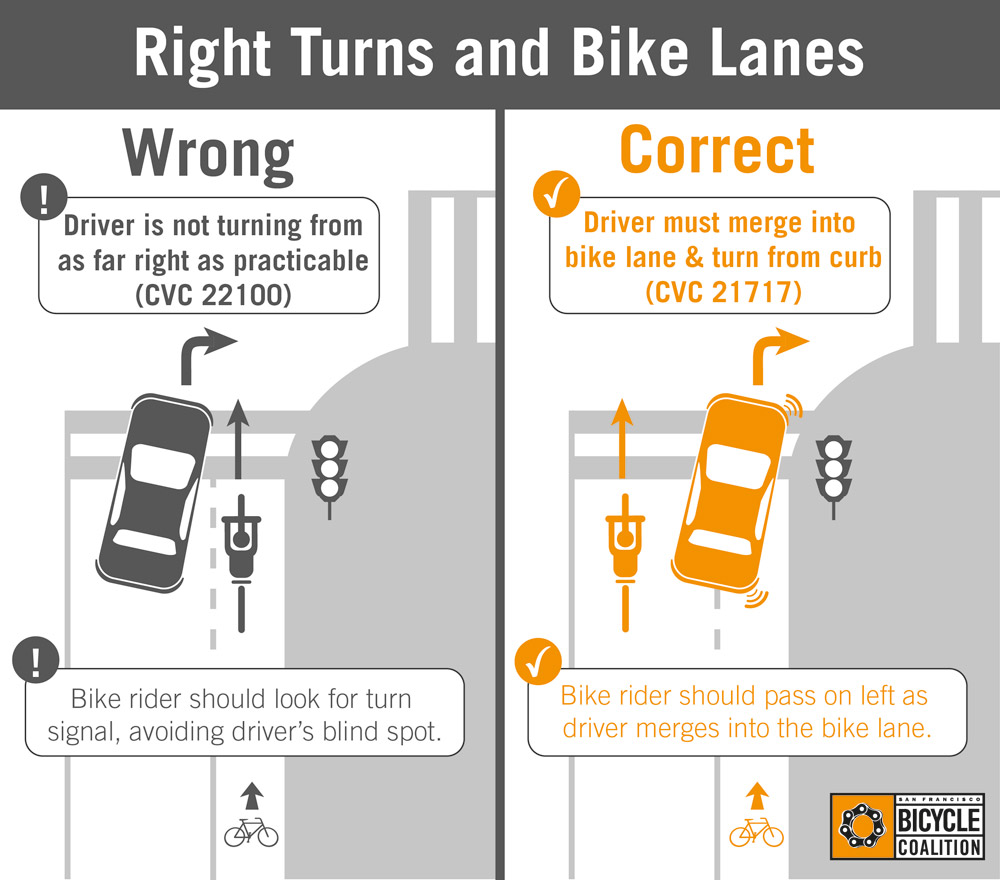
A better design for that intersection would be to keep the bike lane against the sidewalk and the turn lane inside of that, so that they don't cross, and have a "no turn on red" sign, so that the paths of bicyclists and people turning in cars never cross as long as everyone obeys the stoplight and sign.