I think even on 1st gen Zen processor intel had performance/watt advantage though the gap was lower. It's Zen 2 that has completely obliterated intel in performance/watt. Which is almost a bigger shock than the AMD taking the performance crown. Taking both the performance and efficiency crown in a single generation specially when it's not even a full new generation is beyond impressive. Of course it was only feasible with the foundation build up by Zen 1 but it's still very encouraging after the major stagnation that was there in desktop processor for a long while.
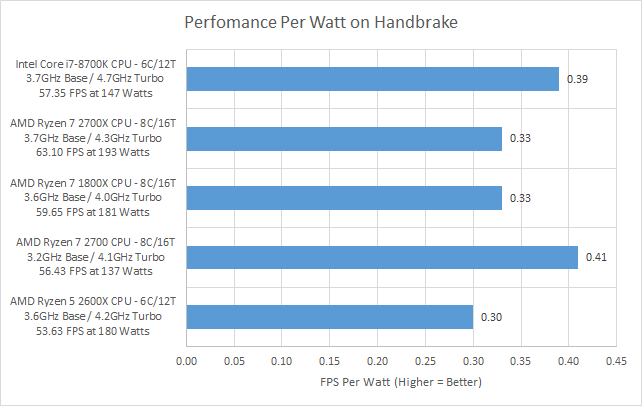
It's going to depend heavily on which specific CPU you're talking about and which specific workload, but at least on Handbrake the Ryzen 2700 was the performance/watt king per legitreviews: https://legitreviews.com/wp-content/uploads/2018/05/performa...
Maybe Intel took that back with their lower clocked 8c/16t chips, dunno, this isn't something that comes up all that much in consumer reviews. But there's at least not a significant gap in either direction, it's pretty much a wash.
The dual EPYC 7601 used 100w less than the Xeon competition in povray while also being the fastest system by a substantial margin at povray, too. Which would put performance, power, and performance/watt all firmly in the EPYC 7601's domain on that one test. And Intel took it back on MySQL. So 50/50 split.
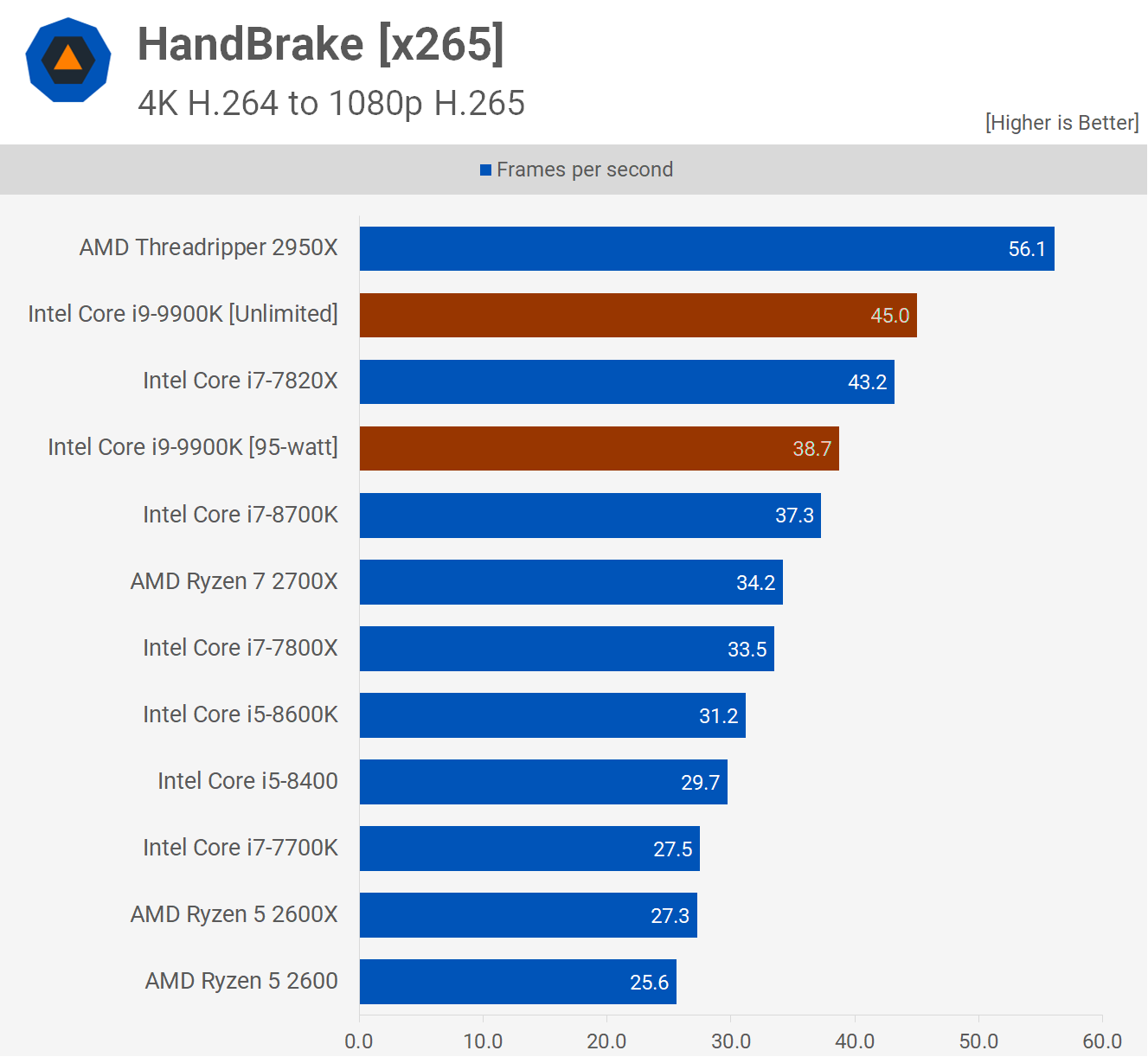
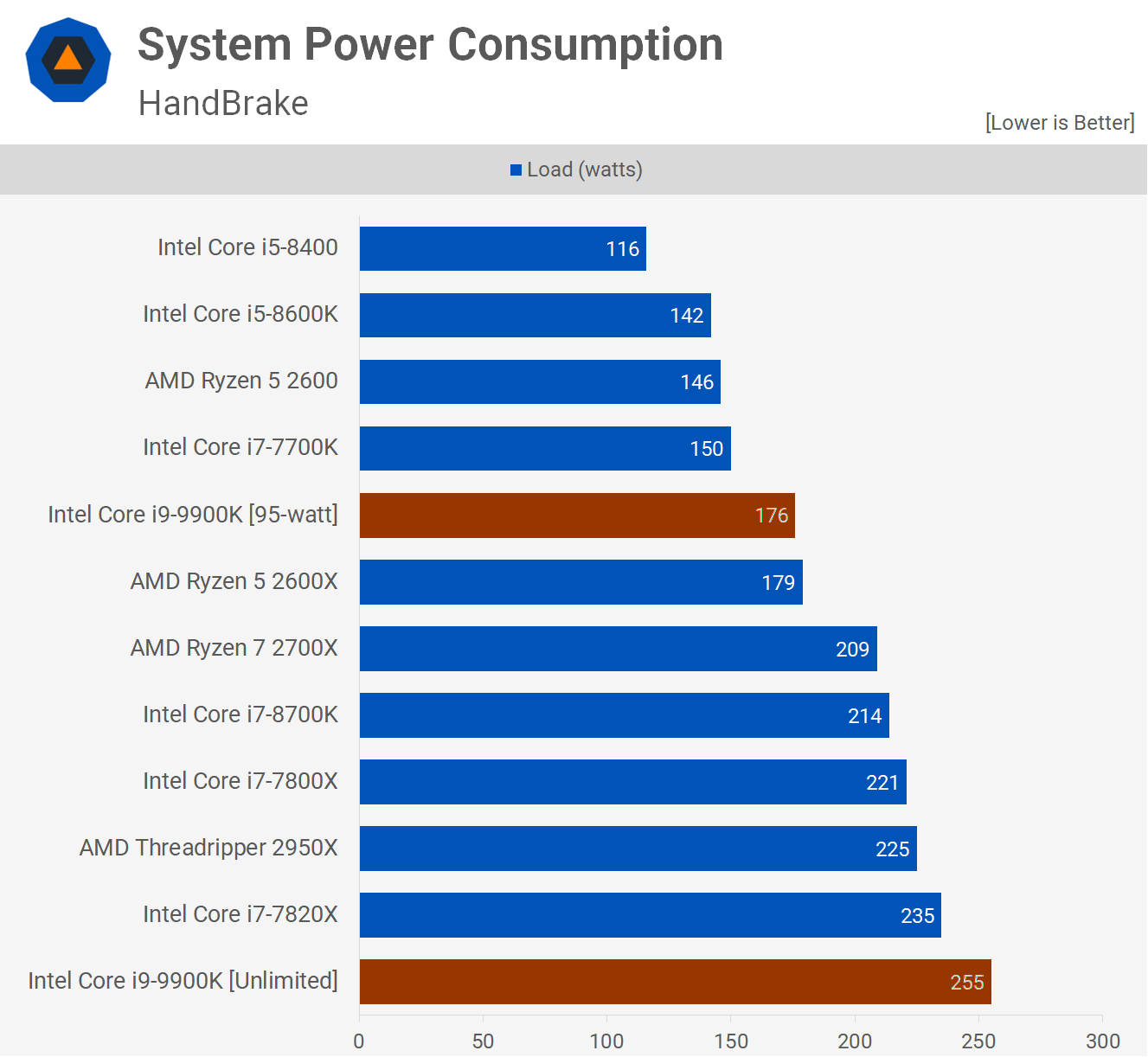
There are a lot of factors to unpack here, but the 8700K has 2 less cores than the 2700X, which is the reason the 8700K is coming out behind. The direct comparison here is the 9900K, but the 9900K ships with significantly higher stock clocks (4.7 GHz all-core), which also reduces its perf/watt.
When limited to its "official" 95W TDP, the 9900K does about 4.3 GHz and has a higher perf/watt than Ryzen (both higher performance and lower power consumption).
So basically you are in a situation where the Ryzen pulls less at stock, has slightly higher efficiency at stock, but has a much lower clock ceiling. While the 9900K ships with much higher clocks and worse efficiency, but has a much lower power floor if you pull the clocks back to 2700X levels.
Of note, the 2700X is actually pulling ~130W under AVX loads (33W more than the 95W-limited 9900K).
The Stilt noted that the default power limit AMD ships is 141.75W and the 2700X will run it for an unlimited amount of time (whereas Intel at least claims PL2 obeys a time limit, although in practice all mobo companies violate the spec and boost for an unlimited amount of time as well). So really "TDP" is a joke all around these days. Nobody really respects TDP limits when boosting, and it doesn't directly correspond to base clocks either (both 9900K and 2700X can run above baseclocks at rated TDP). It is just sort of a marketing number.
Epyc is a different matter and once again more cores translates into better efficiency than fewer, higher-clocked cores. But the gotcha there is that Infinity Fabric is not free either, the infinity fabric alone is pulling more than 100W on Epyc chips (literally half of the total power!).
Similarly, the 2700X spends 25W on its Infinity Fabric, while an 8700K is only spending 8W. So, Infinity Fabric pulls roughly 3x as much power as Intel is spending on its Ringbus. This really hits the consumer chips a lot harder, mesh on the Skylake-X and Skylake-SP is closer to Infinity Fabric power levels (but still lower).
Plus, GF 14nm wasn't as good a node as Intel 14nm. So Ryzen is starting from a worse node.
Moneyshot, core for core, power efficiency on first-gen Ryzen and Epyc was inferior, but of course Epyc lets you have more cores than Xeon. Ryzen consumer platform's efficiency was strictly worse than Intel though.
And that goes double for laptop chips, which are the one area that Intel still dominates. Raven Ridge and Picasso are terrible for efficiency compared to Intel's mobile lineup. And AMD mobile won't be moving to 7nm until next year.
Because of that whole "nobody obeys TDP and it doesn't correspond to base clocks or any other performance level", we'll just have to wait for reviews and see what Zen2 and Epyc are actually like. I am really interested in the Infinity Fabric power consumption, that's potentially going to be the limitation as we move onto 7nm and core power goes down, while AMD scales chiplet count up further.
I somehow completely missed this coverage of Infinity Fabric power usage. I wonder if IF power usage percentage remains the same in this generation or it has been reduced. If not improvement of IF power usage would remain a viable opportunity to make these chips even more power efficient. It seems that given IF power usage it's clear that I was even more uninformed about the power usage of first gen Zen cores.
This is good to know. Are there any reputable benchmarks that show those advantages? Something like FLOPS/watt on some LAPACK or Tensorflow test, or amount of joules to compile the Linux kernel, or anything of this sort?
> It's Zen 2 that has completely obliterated intel in performance/watt. Which is almost a bigger shock than the AMD taking the performance crown.
Why is this shocking? Zen 2 is 7nm and Intel's latest is at 14nm. It would be a far bigger shock if they didn't beat Intel in performance/watt. Zen 2 vs whatever Intel releases on 10nm in the next ~6-18 months is a much more interesting comparison.