> With no constraints on construction will there be a small boom in new development, tearing down virgin forest in order to make empty developments?
Probably? I live in Michigan, which (with the exception of two spots) has no meaningful limits on construction. Even the cities that technically have-and-enforce zoning, waive all the rules constantly anytime a developer asks.
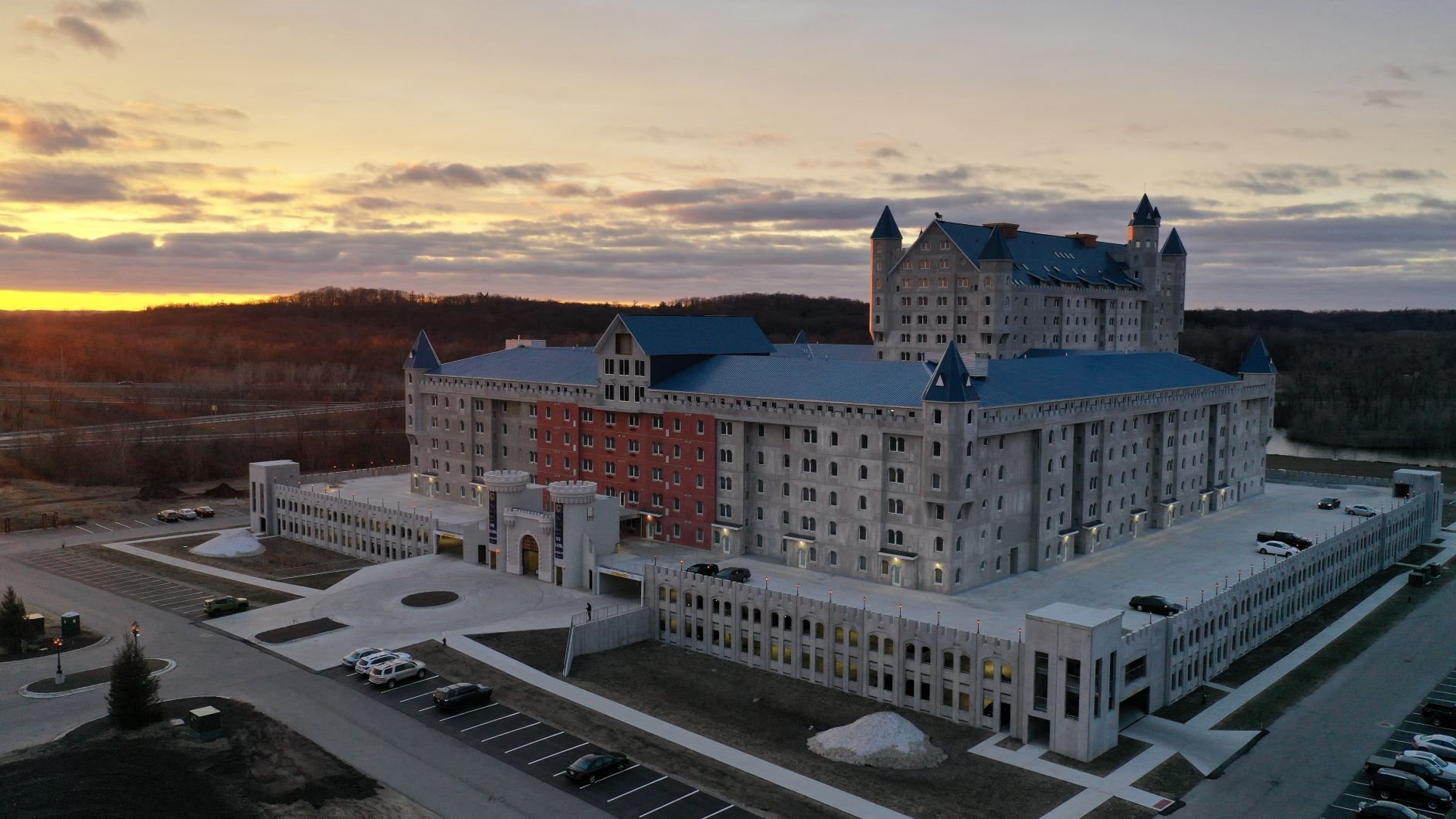
And yes -- it means developers can build almost anything they want, almost anywhere they want. (Truly anything, I live next to a 15-story concrete castle apartment building that a developer built on what was once a trailer park).
Unfortunately, it does not mean you get lower cost of housing (prices here are still astronomical, and while they look cheaper in comparison to California, is only because of the severely reduced income locals make -- prices are still at record-all-time highs)
But it does mean, developers routinely cut down entire forests or farmland for new suburbs anytime they'd like. If you want a house made of sticks and cardboard, we have loads and loads of them for 'just' $450k. Years worth of 'inventory' here.
> Unfortunately, it does not mean you get lower cost of housing (prices here are still astronomical, and while they look cheaper in comparison to California, is only because of the severely reduced income locals make -- prices are still at record-all-time highs)
Are you taking into account the inflation we've experienced? If the mental anchor against which you compare this "all time high" is 2015, for example, then we've seen over 20% inflation. Over 33% inflation since 2008.
My very first thought there was 'here's an example of what could have been ambitious, interesting architecture, except all the public space is devoted to cars instead of people'.
> Unfortunately, it does not mean you get lower cost of housing
You don't believe in supply and demand? I'm not saying you have cheap housing. I'm saying you would have more expensive housing if there were fewer of them, the same way GPUs are more valuable when there are fewer of them.
Induced demand is a thing, as (and much more common) are demand curves that are flat enough that shifting the supply curve to the right by some large fraction of the current market clearing quantity has no discernable effect on the market clearing price.
Real life supply and demand involves more than the simplest Econ 101 illustrative examples of the general direction of the ideal relation.
What you're not factoring in is the cost of labor and materials. They are both already quite expensive and when you have a building boom the costs of both will skyrocket. What will happen is you'll end up with cheaply constructed housing made from the worst materials. And that's the good outcome.
The bad outcome is the rich who are looking for alternate investments will buy up all the labor and materials and build construction for themselves and will build rentals. That's the bad outcome.
The awful outcome, and likely outcome is that the labor and materials will be bought by newly formed real estate companies that will build rental property that is ugly and expensive - because they control the market more and more as they merge into 2 super landlord companys.
The cost of the house itself is nothing compared to the cost of the land. Houses don't appreciate in value because of the houses (which deteriorate over time) - they appreciate because of the scarcity of land.
Sure, but houses don't depreciate as quickly as you might think. There's a few reasons for this:
- Constructing a new building isn't as cheap as when the existing structure was built. For instance, my home cost about $15,000 to build 100 years ago. Today the structure itself is worth more than that. Inflation matters here.
- People maintain and improve their homes. New kitchens, roofs, flooring, furnaces, siding, etc. In essence you are rebuilding a home 1 piece at a time from the day it is made. If you don't then the house gets to a point it can't be lived in.
People who haven't looked at new build prices for 10 years are shocked at what it costs today.
Nothing you're saying is wrong, but it doesn't change the fact that the land is an order of magnitude more valuable than the building (I'm speaking broadly and for residential real estate).
We still have more lumber than land. In a very hand-wavy way we have more labor than land. The limiting factor is always what drives the price.
This is not accurate outside of a handful of broken housing markets. In Philadelphia[1] land is often 1/5 of the total value. There are definitely some parcels that are undeveloped[2] or underdeveloped[3], but most properties are more balanced.
[1] I chose Philly because of a good clickable property tax browser https://property.phila.gov/?p=881576550, and because it keeps separate land vs. improvement assessments.
Single-unit buildings close to downtown can have higher land costs. But single-unit buildings in single-unit neighborhoods are, again, around 1/5 land cost.
These are definitely better examples than you previously used. That said, I think the tax assessments don't accurately state the value of the land vs the building. I don't think OnlineGladiator is correct about the universality of >10x land:building, but I don't think you're right about ~0.2x in these neighborhoods either. I do think OG is correct about housing as an appreciating asset being primarily about the land value.
1) The nominal land cost has huge jumps up and down. From 2016->2017, all of these properties had their land value lowered 60-70%: $150k->$44k; $166k->$59k; $75k->$32k; $279k->$96k. I find it hard to believe that property prices swung that much, especially since the total appraised value remained constant.
2) The price of the land depends on the zoning of the land. A lot which can't be subdivided further or which can't have multi-unit housing will be constrained by what a single family is willing to pay for the lot. If you compare the last property ($140k land assessment / 19k ft2) to a smaller lot nearby [0] ($50k land / 2.4k ft2), you can see a huge difference in the land price per ft2: $6.7/ft2 vs $20.4/ft2. This price difference reflects legal constraints on what can be done with the lot. If the larger lot could be subdivided, it should be closer in price per ft2 to the smaller lot and would be worth ~$390k. If the total assessed value remained constant, that would be 1.25:1 for land:building.
3) Furthermore, the price of the building itself depends on the scarcity of housing. With plentiful land to build new housing, old housing loses value quicker. An old house in a constricted market has more value because it's existing housing on a scarce plot of land. Even though the value is assigned to the building, that building is more valuable because of the plot of land it's associated with.
I used to believe this and then I got into the area. It depends on the area of course but it turns out that the cost of the house is quite significant. House construction costs are $200-500 per square foot, putting even a medium-sized house at around a quarter of a million dollars. When you look at the costs of empty plots of land versus similar plots of land with houses on them, you'll see that the housed plots of land cost the same as the empty plots plus the construction costs of a similar-sized house. In the areas where I looked, the costs of the house dominated, such that the land value is about 20% of the total value of the plot. Even the variance that occurs at that level can be further explained by the value of potential future plots of land on the space -- a plot of land that has one house but could hold a second (for whatever reason) is more valuable than an otherwise-identical plot that can only support one house.
There's a certain cost to build a house. It's not like the houses themselves are more in CA (well, maybe a little), it's the land. For example, my house is appraised around $300k but the land is appraised at $1.2 million.
My 4 bedroom house in Oakland had a replacement cost/value of about $400k. That seemed high but not unreasonable. Then the Santa Rosa fire burned down 1000 homes and insurers realized that construction costs in California are insane (especially when you are trying to build a thousand in a year). Replacement cost jumped to $750k in one year. The land used to be worth quite a good fraction of the property, and then it wasn't.
My home’s replacement cost is way higher than what the insurer appraised it as, but asking for a higher appraisal counts as warning bells in their eyes (are they planning on burning down their home?).
That may be what your used house is worth in an appraisal but if you wanted to build it new, it would cost significantly more I imagine. It depends a lot on finishes and framing complexity of course (number of windows, roof, etc).
A lot of people I know in Colorado found this out when their homes burned down. They had the structure insured for like $500,000 and found out that rebuilding their home that was built 20 years ago would cost around $1,000,000.
A friend recently had a multi story addition put on his house, and of course additions always cost more because there's some amount of demolition and working on an existing site, so the new footings have to be underpinned, etc. It's also a large kitchen and the existing kitchen space had to be demo'd and rebuilt into a new, basic room. The upstairs connected to a hallways but there was some work. Anyways, the cost, all in was over $500k. Even if he didn't use Marvin windows, Wold appliances, nice cabinetry, etc it would have been like $400k. And yes you can go lower. But don't be fooled. A lot of the cheaper construction you see is not only made with awful materials and lazy/inexperienced tradesmen, but is also track housing or similar no modifications allowed type things.
I'm in Austin. I believe there to be inconsistency in zoning here because I'm on the top floor of a 10+ floor residential building looking down on a neighborhood park, single family homes, a motel, and smaller apartment buildings.
The building occurring downtown is insane. I haven't seen anything like it since the booms in Shanghai and Dubai.
> (prices here are still astronomical, and while they look cheaper in comparison to California, is only because of the severely reduced income locals make -- prices are still at record-all-time highs)


Probably? I live in Michigan, which (with the exception of two spots) has no meaningful limits on construction. Even the cities that technically have-and-enforce zoning, waive all the rules constantly anytime a developer asks.
And yes -- it means developers can build almost anything they want, almost anywhere they want. (Truly anything, I live next to a 15-story concrete castle apartment building that a developer built on what was once a trailer park).
Unfortunately, it does not mean you get lower cost of housing (prices here are still astronomical, and while they look cheaper in comparison to California, is only because of the severely reduced income locals make -- prices are still at record-all-time highs)
But it does mean, developers routinely cut down entire forests or farmland for new suburbs anytime they'd like. If you want a house made of sticks and cardboard, we have loads and loads of them for 'just' $450k. Years worth of 'inventory' here.