Can anyone with kids comment on whether or not computers are even exciting and empowering anymore?
When I was eight, we got a Commodore VIC-20. It plugged into the TV and booted into BASIC. Just running PRINT statements and simple loops was unbelievably cool. I learned key positions (and how easily mistakes are made) by spending hours typing in bytecodes printed in magazines. With any luck, at the en of it, a completely unforeseen game would appear.
Getting to play with Logo on the Apple ][e was awesome, too. Shapes and angles and horribly flickering animations were exciting.
Now, it seems to me that the difference between Dive Into Python (or whatever) and Call of Duty are so immense, that even running Hello World would be a disheartening experience. But maybe I'm just too nostalgic.
Incidentally, I distinctly remember from my first proper high school programming course (Pascal) that the instructor asked why we wanted to learn programming. Every single student responded, "to make games."
I'm 19, so I've never experienced a terminal running BASIC on a TV screen or anything else from those early days. I think my oldest memory of computers is Win 98.
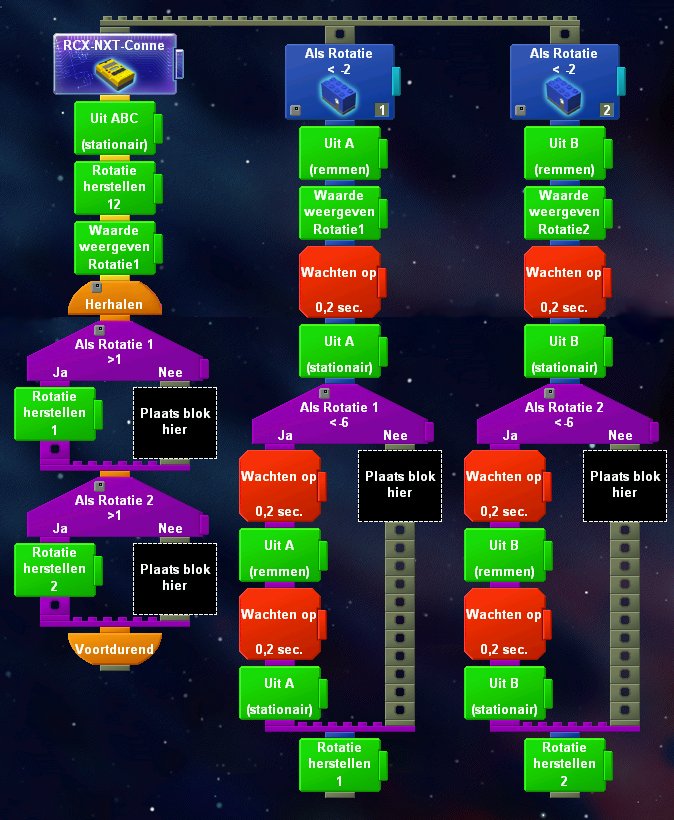
What got me into programming originally was Lego Mindstorms (the original version, the second iteration was no good). My dad and I made robots that could follow black lines on the ground and read barcodes, and it was all with the drag-and-drop interface Mindstorms ran on. ( http://www.bouwvoorbeelden.nl/MindStorms/ShootOut_bestanden/... ) And it was fucking awesome.
It taught the concepts of programming like loops and conditions and variables, but in a watered-down way that took care of the stuff that's not fun for a kid. As you grow you find joy in tackling more complicated things, but as a kid Mindstorms was perfect. Great role-model for any aspiring curriculum in younger education.
Even though it would be way out-dated technology now I feel like Lego should start manufacturing those kits again - they were really amazing. Maybe that would be a good startup idea? Raspberry Pi for kids?
Meh, I mean they are aiming it at education which I think is great, but I doubt many kids would know what to do with Raspberry Pi if you just handed it to them.
My impression is that the main interest in it has been from older people who like to hack on hardware.
That's true of the current ones, but I think the idea is to develop it into a kit with case, manuals, pre-loaded software, etc. to support some sort of programming or robotics curriculum.
Personally, I think it would be neat if the R-Pi could be made into a graphing calculator, which most kids need for their math classes any way (actually they don't need it, but are required to have them). That way, it can be a bog standard calculator by day, and a full Linux workstation by night (after plugging in display/keyboard).
Having just graduated high school a few years ago, I'd say graphic calculators are sort of needed. Most of the time a simpler calculator would do the job and having a $100 Texas Instruments is just a luxury because they're better laid out and show a history of operations like a terminal. Even when graphing and matrices were part of the curriculum, those things can all be done by hand if you really have a lot of time, but it would be harder to learn that stuff without a reference to compare yourself to.
TBH I think books, calculators, computers, and basically every other tool kids use in school will soon be replaced by the iPad, or a similar device. If someone can make a cheaper alternative with R-Pi that catches on (very doable), well great.
I think something more fun for kids would be (apart from the obvious game platform) some kind of communication device. Something like walkie-talkies.. but maybe communicating via IR LEDs with morse code rather than voice. Another idea is using the R-Pi as a counter for a LaserTag-like game.
I've had this project in my head to build a graphing calculator thats a full Linux workstation for some time. It'd be really nice if the display and keyboard could be in the device to start with. Ya know, so I could walk around and use the thing.
There is a lego store near me and trust me, they still sell mindstorms. They have a few different components now but are mostly the same. They cost several hundred pounds however.
Chiming in at 21 as someone who learned to code when 13-14, I actually found the make-a-game approach somewhat boring. I preferred picking up random projects (programming a styrofoam Roomba with proximity sensors on a BASIC Stamp, building a graph algo that would solve a Rubika cube, etc.).
Maybe it's because I was always more into board games than video games, but I don't think the games-size-fits-all mentality is universally appropriate.
Generalising it to task-oriented (versus skill-oriented) learning may be more precise.
I second this. The whole 'video game' and game mechanics culture of most intro programming actually kept me out of it for awhile. I truly dislike making and playing video games, but I enjoy writing useful software and learning about cool topics like computer vision.
I'm not a kid, but I'm late enough to the game to be considered a youngin'. My first computer was a 160mhz Win98 box.
I started programming in '99, when I was invited to a programming class by my typing teacher. His first year long class were split between C++ and Visual Basic. Don't cringe yet! The first semester was all C++ to learn what it is to program in a strict language. The second semester was VB because, now that we did the hard stuff, he "wanted us to have fun with programming." That's when we made all those cheesy games, like tic-tac-toe and connect four. If we wanted to continue next year, it was all C++ for the rest of the curriculum. I ended up buying a C++ and Visual Basic compiler just to program at home.
I believe a group of peers really helps bootstrap the learning process. You want to compete to learn more to create cooler stuff to share and get excited when a friend pulls off something pretty spectacular. Excitement and passion are contagious as all hell.
I was also part of the "I wanna make games!" crowd as well. At the time I was playing Half-Life and Starcraft. I think deep down you know that it will take work to make those kind of games, and so the "Hello World" program doesn't seem so bad because you are only learning. I also think games precondition you to learn the basics since most start out with a tutorial and a gentle learning curve that build on things you learned before. In a way, programming is one long protracted game. I would be curious to see if being a gamer today correlates with getting into programming more often, even if you don't end up making games.
I'm not exactly a kid anymore but I never got interested in programming because I found everything somewhat simple that I could actually program myself already existed. All the crazy stuff that I wanted to make was completely unachievable. So I never really had any positive feedback from my work. It was either stupid and redundant or died on the vine. Not much fun.
My six years old son is currently learning (fast) to read and write and he already wants to be "hacker"; either "white hat" or "black hat", depending on his mood.
I don't think he sees computers as "magical instruments", though. He is excited by them, by the games he can play on them, by the knowledge he can acquire with them, by the code I write on them… of course. But he is certainly more used to them than I was at his age. To the point where, when coming back from a computer lab organised by his school, he says "I'm not very good with Windows, I prefer mom's computer or yours".
I mean, he is only 6 and he already prefers one platform over another.
I'll wait a bit before his first "Hello, World!" (English not being our first language), but the chances that it's going to be a flash game instead of a small command-line executable are pretty big.
hey, I learned on a Vic-20 too. Loved it and (to my parent's dismay) spent far too much time writing programmes than doing "normal" kid things. Then one day I got a book - something like "How to write adventure games". One of the best books I've ever read. I loved it
This book showed me how to design and write, from scratch, a real adventure game. How to design a game and draw maps (well, I was pretty accomplished at that already), how mazes worked, how to parse and handle the standard verb-noun input. Everything! I remember writing games and taking them (on cassette) to show my teacher at school. Awesome times.
[Edit: I've spent the last half hour looking, but no joy yet. It's not "Creating Adventure Games on Your Computer (Tim Hartnell) nor "Write Your Own Adventure Programs" (Jenny Tyler and Les Howarth)
I have two kids. The time at the computer is deliberately limited, so they aren't into games that much, although they like the online games, etc. Not into programming either, they didn't even pose a question 'how is this program made?'. To them it's more like a whole self contained thing. Like a car. You don't sit in a car and say 'I don't like the curve of this seat, I'll hack this afternoon and see if I can come up with something better'. I hope you get an idea. What they do like about computers, is that they can use them to create something - drawing, presentation, writing. In fact, both are really into writing - trying to write novels and short stories. So computer to them is like a tool, which you can use to create something, but not modify itself.
I started off trying to make games. Along the way I noticed all the other (Way cooler) stuff going on behind the scenes and dropped them.
Anecdotally, this seems to be the same story for the few people I know in real life who claim to know some form of computer programming. (Whose claims I actually believe.)
I can vividly remember typing in stuff from the programming manuals when I wasn't older than 6... freaky stuff, I think my very oldest vivid memories are coding memories.


When I was eight, we got a Commodore VIC-20. It plugged into the TV and booted into BASIC. Just running PRINT statements and simple loops was unbelievably cool. I learned key positions (and how easily mistakes are made) by spending hours typing in bytecodes printed in magazines. With any luck, at the en of it, a completely unforeseen game would appear.
Getting to play with Logo on the Apple ][e was awesome, too. Shapes and angles and horribly flickering animations were exciting.
Now, it seems to me that the difference between Dive Into Python (or whatever) and Call of Duty are so immense, that even running Hello World would be a disheartening experience. But maybe I'm just too nostalgic.
Incidentally, I distinctly remember from my first proper high school programming course (Pascal) that the instructor asked why we wanted to learn programming. Every single student responded, "to make games."