In general our lab was very good at research & the rigidity of current academic institutions means that
1. admins are always the first hiring priority
2. academics do a ton of free work in publishing, service to their institutions on panels and committees, etc.
The leadership above our program head were so entrenched by block grants, & their de-facto recipients, that there would be fights over post-doctoral salary increases on the $5k level.
We had more money, which we won on competitive contracts, meaning if we won new contracts we could pay for better people... this was not welcome news to block grant recipients who had, essentially, fixed budgets & old mindsets.
The result is, as it typically is, driven by incentive structures.
There are a few different things defining the incentive structure:
1. Management by private institutions : National labs within the US are no longer managed by the government, there are LLCs which charge statutorily limited management fees of ~7% of lab revenue. The higher the revenue, or higher the operating budget, the higher the $ accumulated by the management company.
2. Liability limitation : Large science orgs, in the US, are deathly afraid of lawsuits related to personnel & the business of conducting science (ie employing lots of people who may test the boundaries of technologies, materials, & etc which could be hazardous long term). Typically government institutions are self-insured institutions, meaning there is no insurer who will underwrite their liability in the event of an incident. Safety & Admins are deployed as inertial dampening on the approvals of new research efforts. Admins also dilute responsibility for decisions made high within the orgs, via a hierarchy of admins that looks more like links in a chain: one admin reports directly to another admin, effectuating potentially arbitrary delays and dilution of scientific input on decision making within day-to-day operation.
3. Incumbency of older guard : Block funded scientists (the majority of whom were hired 25years or more ago) will get staff positions within large science orgs, because there's no risk to continued employment of that person long term to the org. Staff have all the political power at my old org, therefore staff positions [=] influence to drive the org. Older scientists are reluctant to cede political power, but also do not have dynamic budgets. Their task is to run projects with cutting edge science on, mostly, post-docs & grad students. Paying more for labor means they will have fewer papers, the scientific currency.
I know that the situation at Los Alamos was, at one point, 5 administrators to 1 scientist. That doesn't jibe with the 7% figure op there, but I imagine I don't know what a management fee corresponds to. The administrative overhead at LANL seemed to be completely unlimited.
Every public university I've participated in has had an ever expanding court of nobles that don't do anything except give the universities money away to each other and consulting groups (who ironically always recommend cutting off the heads of the nobility).
Departments are stuck seeking out private funding at this point, which doesn't seem like it should be legal, but it seems to be unprosecuted at the very least.
The incentive structures of those funding the university's research department. In many cases, state governments, who themselves are run by congresspeople responding to the incentive structures set out by voters. Those voters are themselves tactically voting to get the best possible outcome in response to the incentive structures set out by voting systems. And the people who decide what the voting system is are the congresspeople they're voting in, who have an incentive to keep the system as it is so they can stay in power.
In other words, it's incentives all the way down. At the national level, there are other factors that dilute the influence of this infinite regression of incentives, such as geopolitics, war, etc. But for states the only real factor that shines through - the green tint in our infinity mirror - is "how much money do we want to spend on secondary education" and the answer is invariably "less than last year" and "can we find someone else to pay for it?"
If coal is equally distributed among all people, then the utility to each person for burning their coal is more than offset by the (negative) utility of everyone burning their coal.
Voting is what allows us to overcome this sort of prisoner's dilemma, and prevents coal from being burned when it hurts society in aggregate to do so.
If instead, you adopt a system where how much you own decides your voting power, then when the coal gets concentrated enough, it doesn't matter how bad it is for society, that coal will get burned, because the voting power is concentrated among the people who benefit from it the most.
Saying voting is the source of this incentive structure is ignorant.
The voting I'm referring to is the actual democratic system of each state government that funds the schools, not the shareholder """democracy""" of one share one vote.
In other words, the government cannot do bad things, only private companies can do bad things. A very enlightened point of view. Great that you corrected the people with actual experience.
I said that it's incorrect to describe the bad things the government does as being driven by "voters acting tactically". It's not even rational to vote. Changing what I said so that you can disagree with it more easily is also dishonest.
Voters can certainly be selfish, in the sense of wanting something that might conflict with the greater good. For example, I might not want a new sewage treatment plant in my neighborhood, even if that is what the greater metropolitan area needs. I might want NASA to keep open a local office even if that interferes with efficiency.
And there's nothing irrational about voting. Maybe it is irrational to spend a lot of time reading about obscure candidates for assistant deputy dogcatcher, but you can just leave those choices blank if you want, and just vote on the things where you already have a strong opinion.
A related read is by Fei-Fei Li, who wrote more details about her point of view in a November 2023 article in The Atlantic [1]. The submitted article in The Washington Post focuses largely on the funding disparities, which she does highlight in her own article.
But her article in The Atlantic places a greater emphasis on the effects of a brain drain of AI researchers from academia to industry. She gives examples about how 40 roboticists left Carnegie Mellon for Uber in 2015, and how her close collaborator Andrej Karpathy chose OpenAI in its earlier days over "a faculty offer from Princeton."
She most notably recalls a quote said by someone at an OpenAI meeting that said that "Everyone doing research in AI should seriously question their role in academia going forward," and added the reflection: "To be honest, I wasn’t sure I even disagreed."
Uber left the self-driving car business four years later, selling that division to a startup. Did this work out well for the researchers, or did they end up getting a raw deal?
This trend heavily biases AI research towards Google problems. Perhaps things will swing away as LLMs (and especially smaller LLMs) take over the field.
I would not use publication numbers to argue anything. I'm an ML researcher at a university and publish at places like NeurIPS regularly.
There are so many edge cases that render this data meaningless. There are people who have their name on a dozen papers. Reviewers are terrible and papers with a lot of graphs run at large scale and easy messages tend to get in (I'm not saying that this is the only thing Google publishes, but people with access to a lot of compute tend to publish papers like this).
The funding gap between Google and academia is also massive. The fact that we're still competitive with Google is simply a testament to how incredibly efficient universities are and how inefficient Google is. They pay their people several times what we get paid. They have engineers which we don't. They have orders of magnitude more compute. They don't waste time on grants. Their total AI research budget is larger than the total combined AI research budget of all US universities. But.. somehow, they still account for only a small fraction of papers.
> But.. somehow, they still account for only a small fraction of papers.
They are only going to publish results which have no effect on their competitive advantage as a business ... which could be a small fraction of their results.
Business is built on engineering. That's what they spend the vast majority of their resources on.
No one has any secret sauce science at the moment. And if they did their engineers would be bragging about it in private, bringing it to new companies when they move, and we would be seeing it in products or features. Heck they would be telling us when they apply to grad school.
Imagine if Google didn't publish the transformers paper, Google does not just do engineering they also do research. If they find something similar today it wont go into the public since OpenAI set a precedent of not saying what they do.
If Google didn't publish the Transformers paper their engineers would have given talks about it, would have used those ideas to apply to grad school, would have switched companies and built a similar model that's just different enough not to technically be the same, and we would have reverse engineered it immediately. Simply knowing a few keywords would be enough for anyone competent to reproduce all of the work.
The space of possible models is huge. And we don't know in which direction to go to build better models. But knowing the vague general direction is all it takes. Any researcher can follow along given that knowledge. That's true of a lot of science not just ML.
In the past when I was in academia, I saw a really interesting model: you have a faculty position at a university or a national lab. But you also set up an "Institute" which is independent from the U or lab. Instead it's an LLC owned by the faculty. The institute applies for grants ("wearing your institute hat") and the resulting grants are not subject to the university or lab overhead. Instead, that overhead goes to fund the admin structure for the institute, which can be far more minimal than a typical research institute.
With an approach like this you can get $2-5M/year in funding, hire 1-2 really good employees, and use the rest of the money to pay for cloud infra (or on-prem or other infra if that's your preference). And of course, any ideas you have, you spin off into startups that you have equity in.
Yeah, this is also good for donors. When you donate money to a professor's work through a university, the university ends up taking maybe a 30% cut. But if you donate to some independent institute that's controlled by the same professor, the university gets no cut.
It's annoying organizationally, though, since employees can't just hop between the sides. So it makes it harder to have a sane reporting structure, and encourages the pseudo-flat "nobody technically has a boss but also nobody is empowered to promote you" academic style.
So many insightful comments, I don't know this adds much but "basic cost of living" or "living reasonably" has gone up fairly exponentially in the last 10-15 years. Most people in academia, if they were on the fence at all about going to industry, are probably jumping.
In some not so distant past a family could live on a single-income, one person is an associate professor at a university type arrangement. These days without dual-incomes it's anomalous if you can even afford to buy a home.
It's a circular problem too because the recent waves of "tech boom" + after-shocks from CV19 and associated economic "policy" the slope has become even steeper.
It doesn't help that modern academia, if it was really ever different, at the graduate, post-graduate and doctoral level is basically indentured servitude. There's a reason why most graduate programs are filled with "foreigners", it's no different than H1B abuse in the tech industry -- unversities know they can abuse this work force for peanuts.
So if you just finished your PhD after doing 70-80 hr weeks for the past 4-6 years and you have choice A) Continue the same and hope you can get a crack at your own research team B) Get a job, work ~10hrs/day and afford to buy new clothes, a decent car, eat well and not live in a shack, you'd likely pick choice 'B'.
Has the cost gone up, or have expectations? None of my friends paid for subscriotions for anything but a landline, cooked moat of their food, and wore years old clothes a couple decades ago. People consume at a much faster rate today.
This might be a US-centric experience so I'm prefacing...
Basic cost of living is : rent, food, utilities. Those three have gone up astronomically, especially in the past 3-years.
A graduate stipend is probably $22K/year, maybe more for a PhD student. 20-years ago that was reasonable, if rent is $1700/mo you're already underwater given you have to pay taxes on that meager $22K.
In my graduate experience, I didn't see most grad students walking around with the latest cell phones, laptops or luxury goods, they struggled with the basics.
A number of graduate students at various universities are going on strike and forming unions and honestly more power to them:
Some of them are great but then I remember when I was floating around research labs some grad students would cry and tell you not to do what they were doing because its miserable. But then life has many fun horrors does it not?
It seems like SWEs are a dime a dozen now, and they will “come to you” - but I’m seeing more and more internships and roles seeking PhD grads/undergrads for roles that traditionally you may have seen just this as a nice to have or a plus.
I’m convinced these secret founders Signal group chats are all just CEOs saying how scientists and academia persons are really who they want working for them. My hunch is that they will most likely be less enthralled by the usual tech bubble that these companies tend to hire in, less problematic, and “less company focused” (focus on the task at hand, don’t lean into company culture or ask questions, follow the straight line).
This story is at least a few decades old. The only reason to stay in acedemia as a computer scientists/software engineer is if you want to focus on cutting-edge research or otherwise have a passion to teach others. Industry will outbid for everyone else.
I think in the last couple of years more established people are getting back to Academia. The sad part is not SV pricing out academics, industry has massively influenced academic conferences and has resulted in a lot of herding and a lot less tolerance to novel/fragile ideas. If you have not bench marked your idea on some large databases (costs multiple thousands of dollars) your idea is not worth publishing. This has resulted in explosion of incremental ideas and reduced the tendency of people to explore on their own which is perceived to be too risky.
Is academia supposed to compete? I think the researchers wish for that, but that's not directly how government funding agencies see it. From a government's funding perspective the goal is to train tomorrow's workforce. People learn in academia and then transition and contribute outside. As far as agencies like DOE go, that is an explicit goal.
Recently talked to a DOE program manager. I confronted them with the question why we do things like machine learning or quantum computing in academia, when there's no hope in matching industry for those things. His answer was that from an official perspective this isn't the goal, but future workforce training for national interests and security. NSF might differ slightly, but I think this makes sense.
Similar to math teachers and programming. Most great math teachers can easily convert to at least mediocre programmers. And that translates to a 3x+ salary increase on day 1. I know people who converted.
They can compete the exact same way that those tech companies compete with each other: compensation.
Pay more, or offer enough other perks to entice employees. Teachers already have a massive perk in the fact that they work ~1/3rd fewer days than other jobs. That's a great draw, if you can offer good enough compensation to get over the "not making enough money to live a comfortable life" threshold.
If people will risk their lives as cold-water crab fisherman for the right price, there's certainly a price to put up with highschoolers.
For the people I've known who've left teaching, it's never been about the money, or at least they've always said it wasn't about the money. It's always about the working conditions, partly the kids and parents but mostly ever-increasing bullshit from admin.
They work longer days than most people and also have the privilege of working with increasingly shitty kids and their awful parents, in large class sizes. The long vacation is frankly not worth it.
For most it's not a vacation, because it's not paid. You can't exactly get a second job during the time, who has work that is 1) not awful and 2) only needs extra labor for 2.5 months during the summer?
Teachers probably don't want to run ice cream trucks
That's funny because I know a lot of people on the other side of the fence that leave teaching for even lower paid work because it is miserable and unfulfilling.
Given this knowledge, it's hard to you comments like this any differently than comments from googlers talking about how fulfilling it would be to work a construction job or romanticize pre-industrial Society from a downtown penthouse
Why not become a private teacher, aka trainer / instructor. 3x may not be even close to the top of the potential upside (if using modern elearning tech, and having good subject knowledge and some decent marketing).
Ah yes, just what teachers love doing, being monetarily beholden to the parents of the little brat causing all the problems because they pay $50k a year
That's partly because due to the fulfilling nature of the work (a compensating differential), and partly because we can't price it (how much is it worth?)
My crazy and political idea what will fix all problems is to give proxy votes to parents for each of their children.
A lot of teacher salary problems come from idle retirees outvoting children on personalised social care vs mass school funding. There is no reason for children to have absolutely no representation in government.
Convince the population to tax tech monopolies and billionaires.
We don't need to triple teacher salaries. We need to give teachers better tools so they can teach material they don't know, same as how managers can manage employees.
We also don't need to stop private industry, we just need to open their work to benefit society as a whole.
A point I've been making for several years is that the pandemic changed everything. Academic jobs are no longer viewed as having the special status they had even 10 years ago.
How do universities compete? They can't, but they don't need to right now, because they've got a large existing stock of employees that have heavily invested themselves in the academic enterprise. That's a problem for a decade from now, but few administrators think ten weeks into the future, much less ten years. They'll still have a plentiful supply of humanities faculty, so at least that 10% of the university will be okay.
Pay better, open up more slots for tenure instead of forcing all work to adjuncts, and spend more on research. If universities are supposed to be distinctive for their research, their highest paid employees should not be football coaches.
Physics academia has the same problem. Maybe worse. In some physics subfields, postdocs are just writing Python code most of the day. There's a lot of financial incentive for the best ones to simply ditch physics.
It's hard to feel bad for universities when they've always taken whatever money they've had and hired layers and layers of bureaucracy instead of paying professors.
That does not explain why they were doing fine before; the US has had universities for centuries. Why did Parkinson's Law not set in from the beginning?
Considering the colossal waste of money almost every academic institution spends on activities that are entirely peripheral to research and teaching, I'd say good riddance.
One point that seems to have been lost in the comments is that academia is a 'safe space' for tough questions, theoretical questions, questions that don't have a profit motive.
The degree to which they actually tackle those things is debatable, but there is value in research that doesn't happen on the exclusive behalf of shareholders.
To me "This system is broken because of bad organization and institutional incentives which led to a bloated and useless admin structure which ultimately led to poor research outcomes. Also funding is very low and all the good people went elsewhere." seems like a problem that solved itself.
There's something very strange about the phrasing here. "X is getting priced out of Y" is generally invoked to get someone to feel empathy towards the party that is getting priced out. E.g. "The urban poor getting priced out of a gentrifying neighborhood" -- this is very much NOT that.
I can think of a whole set of things academia could change to attract more talent, and most of it wouldn't even cost much on the part of the university aside from professors and administration having to take accountability for various toxic behaviors of the department.
Universities deserve far more of the blame. It’s too bad this article doesn’t mention the exceptional difficulty of the tenure track. If schools wanted to attract more researchers, they could. Although it is true that academia can’t match industry salaries, they could probably be closer if they paid researchers what they pay football coaches, presidents, and other administrators.
Almost all breakthrough in human history are not triggered by money but talent meeting opportunity. So why worried about someone wants to take a job (research or not) because he is getting paid higher?
Have you heard of the MIT AI lab and Symbolics? During AI spring it generally would switch to situations like these. We don’t pay a good enough wage to researchers so they get out of academia .
Don't forget the dot-com boom and bust of the late 1990s. For three or four years it seemed anyone in academia who even just knew HTML was jumping ship to a dot-com and their insane salaries. A few years later many of them came crawling back to their old institutions, desperate to get a job.
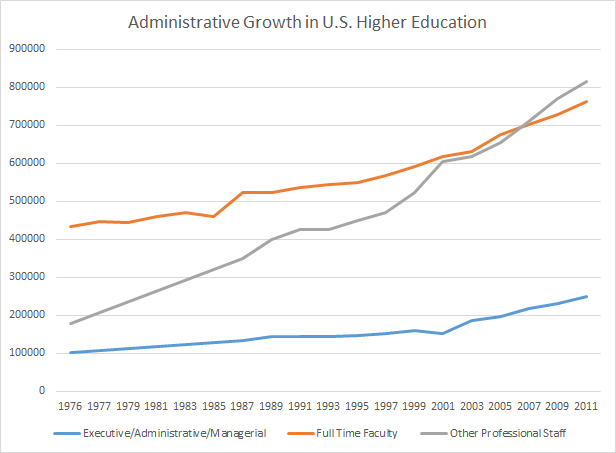
Eh, how about firing 50% of the administrative staff from universities per this graph:https://philmagness.com/wp-content/uploads/2016/03/AdminGrow..., and definitely all the DEI staff and half the social study programs? And how about cut all the sports teams unless they are generating profits? How do sports jockeys have to do with academics anyway?
This may be fading, at least a bit. One administrator of a top CS department told me that a number of the tenured professors were coming back from their time in industry rather than give up their tenure. So it would be easy this fall to staff the courses. The recent 10-15% layoffs around the FAANNNG world was the source.
~15 years ago in automotive, juniors making 60-80k/yr. Most engineers were making a nice 100k+/yr. Experts making ~20-60k more. Top of field can make your 300k+ with consulting.
Academia? Oof, 40k/yr starting, never breaking 90k.
Your best talent basically goes to industry due to the forces of capitalism. The 22 year olds getting masters/PhDs were seen to be the failures who didn't get a job.
Now if you talk to the people in Academia, their prestige was well worth the cost of living on an assembly line worker's wage.
My favorite academics in the automotive field were the ones who had already been in the the industry for long enough to make their bag and had come back to teach because it was fun.
The head of the automotive program at my alma-mater was very well off and was completely open about the fact that he did consulting on the side if he wanted cash for a new truck or something. This also made him considerably more immune to administratorial university politics.
A lot of university bloat and wasted resources came from the fact that the various regents, deans and heads of so-and-so wanted their fingers in every pie and would push various "initiatives" that academic staff were expected to support (which would then be a notch on the belt of the administrator who created it, giving them power to hire more staff and create more initiatives).
There were a lot of levers that could be used against academic staff who focused too hard on teaching or supporting grad students. Loss of lab space, no grad students funneled to them, etc. The people who'd already "retired" once and were only there to teach were basically the only line of defense against this type of stuff, because they simply didn't care.
Government funding would just result in boondoggles like the old national supercomputer centers from the 1980s. Giant, overpriced one-off machines of types never sold to commercial customers, surrounded by large administrative organizations and located for political reasons.
> Government funding would just result in boondoggles like the old national supercomputer centers from the 1980s.
I don't know if I totally disagree, but I think it's fair to point out that one of the most society-changing inventions of the past 50 years came out of one of these "boondoggles": NCSA Mosaic, which basically led to Netscape: https://en.wikipedia.org/wiki/Mosaic_(web_browser)
I say if hype is getting competent engineers and scientists a lot of money, this bodes well for a post bubble time when they are cut loose and decide to invest their skills and money into new ventures.
Having recently spent quite a bit of time in Silicon Valley for the first time... for the supposedly richest area of the richest country in the world, wow, what an underwhelming experience, that money you're spending doesn't give you anything compared to NYC or even Miami.
Completely unwalkable, no transit, freeways and highways everywhere, no bustle or nightlife even downtown on a weekend. Extremely limited culturally. Large parts of it feels like a third world country. Just what.
Sure there are some redeeming qualities like being near the Bay and great hiking, but I can think of countless other places I'd rather exist at any compensation level. (including nearby SF which has at least some city qualities and amenities)
You've just described every city in California. If you want to enjoy CA's weather and environment, this (or rural life) is the price you pay. For some of us, avoiding bustle by living in the suburbs is a benefit. Do the downtown areas shut down too early? I thought so in my 20s, but now that I'm in my 40's I don't really care.
Also, some people include "nearby SF" when referring to SV. I disagree, but especially since Uber and other companies got big, the geographic definition expanded.
"Silicon Valley" has always meant the southern Bay area, not really SF itself -- Mountain View, Palo Alto, San Jose. It's only recently when tech companies started opening offices right in downtown SF that people meant SF when they spoke of the Valley.
I agree that it should just refer to the southern area, and it's possible that as SF has hollowed out and doesn't have nearly as many tech workers it will return to that definition.
But it's not just tech firms — sometimes law firms and other types of companies will open an SF office and call it their "Silicon Valley" office.
Misses the point of academia. Neural nets and back prop came from a very small niche at the intersection of computer science, psychology, and neuroscience. Working with limited resources is a feature, not a bug, of innovation.
What is 'wrong' with this? Academics at these research labs are still doing academic work, including teaching and mentoring colleagues. The main 'issue' is likely that some college administrator is not getting their cut.
Oh pity the poor colleges... how will they fund their over-the-top, debt-financed facilities and football teams?
There’s a little thing called the profit motive. Universities aren’t perfect but few other institutions have deliberate spaces for non-commercial work.
Ivy league schools in particular are essentially just endowment funds with some teachers around to keep their non-profit status. There are plenty of great educational institutions out there but the most prestigious ones are suffering from their success and attracting money-minded management that is more focused on growing their investment portfolio and handing out juicy bonuses than attracting good staff and ensuring a good educational environment.
And even with all that universities still have better a more altruistic profit alignment than most private firms.
> There are plenty of great educational institutions out there but the most prestigious ones are suffering from their success and attracting money-minded management that is more focused on growing their investment portfolio and handing out juicy bonuses than attracting good staff and ensuring a good educational environment.
People keep trotting this line but without any substantial proof. Harvard's highest paid employee is a faculty member, David Malan, of the popular CS50 course earning $1.6 million annually [1]. It's always been faculty members earning even more than the President.
I assume you're counting Harvard Management Company, the firm managing Harvard's endowment. Yeah, the CEO earns $9 million annually, which is quite high [2]. But there's a catch; were he in the private industry managing a $50 billion+ fund, he'll easily clear $50 million+ in annual compensation, if not $100 million depending on the performance.
The endowment managers operate differently from the institution, and salaries are actually much lower than in the private sector. Maybe you want to complain about inequality, sure, but that's another thing entirely. They're paying the least they can to get expert fund managers..
The number of $100 million+ buildings a New England town of 8,000 can have is staggering. The problem is the idle hands and minds these buildings house. The number of administrator looks like a make work project to create more jobs.
Yes and the administrative areas take up to 50% of all grant funding as "overhead"
Some overhead is necessary of course, you need buildings and offices and the people who take care of them but it's likely more bloated than it needs to be.
At least in the US, an institution’s “facilities and administrative” F&A rate gets negotiated with the Federal government every four or five years.
I know of some institutions with F&A rates at or above 70%!! I presume that an institution trying to negotiate a higher F&A rate than this would have some significant pushback!
70% is not that high these days -- there are institutions (normally non-university-affiliated research institutions like the Salk Institute that still apply for NIH and NSF grants) have overheads of 90%! It's important to realize that overheads aren't taken out of the grant given to the researcher, they are added to it. So if a researcher gets a $100K grant at institution with 70% overhead, the institution gets $170K.
Many grant giving institutions limit what they are willing to pay. For example, from my understanding the European research council will only pay 25% even if you university demands more.
I think the profit motive thing is stupid. It only matters if the organization itself is a volunteer organization. For example, if an organization is being run by nuns, I agree that profit doesn't matter because nuns aren't allowed to own any assets or have an income (by their own profession of course). However, in a 'normal' non-profit organization, the various stakeholders (employees, grant recipients, etc) actually have a huge profit motive.
To me it doesn't matter if a CEO is working to get money for investors or to pad his own pockets. at the end of the day, the incentives are the same.
So, no, I don't think this matters at all. While true that universities do have space for non-commercial work (which is usually funded by outside parties like the NSF or corporations anyway), the university leadership have a huge profit-motive to get more students (via attracting to professors) to pad their own pockets.
In some ways, the non-profit sector is even more self-serving than the private one. At least private companies have to seek the best for their investors, while many non-profits simply seek the best for the CEO.
This hyper focus on CEOs is fascinating to me. Everyone acts like CEOs are dictators that enslave their people. It's likely the other way around and we have to pay them so much because nobody would do the job otherwise.
Managing an organization of any complexity is like herding cats. It's got a life of its own and you're at the top just leaning on the helm trying to steer the ship 2° starboard.
Any large group is going to form into a hierarchy naturally. The senior leadership at any large organization are ridiculously talented individuals at the tops of their classes. Half the reason the top jobs pays more is to signal the hierarchy.
I have nothing against ceos. More power to them. I have an issue claiming that a well paid CEO at a non profit is not motivated by his own potential profit.
But that research is important and benefits us all - so, with how much excess and wealth stratification we're seeing in the modern world, isn't it worth it to divert some of that to supporting that research? If we're too focused on profit we'll optimize for a local maximum and miss out on highly impactful developments that might initially seem to be dead-ends.
The NSF and DoE and other government agencies make insane amounts of capital available for research. The CHIPS act included ~$53 billion in funding on its own.
If you want to do AI research along a line that doesn't seem to currently represent big immediate profits, you aren't going to be competing with SV firms anyway.
You still have to get grants and all for that area, and then "profit motive" of one form or another might sneak back in, but that would be true even without SV firms as well.
A risk of proprietary research is that the company can hoard knowledge, exploitation thereof, etc. It's the suboptimal quadrants of the prisoners dilemma.
Because this is the internet I can't be certain if you're being sarcastic or not but in case you aren't... a lot. Life isn't a pursuit of profit and if people's training is solely devoted to that they'll miss out on a lot of the stuff that actually matters.
football teams are a revenue generator for the top few universities that have football teams worth following. For all the strivers out there, they're not.
That's the athletic department as a whole. At my alma mater, which is on that list as one where the athletics department costs 500-1000 per student, our football team (which is consistently mediocre) and basketball team were, as far as I know, profitable, and subsidized other D1 sports. I believe that cost also covers the funding for things like intramural sports, the student athletics complex (gym), and various other athletics adjacent things that are student-services shaped, and not D1-sports shaped.
There is not a single school in my state that makes a "profit" on any of it's sports programs. Anything outside of D1 has no chance in hell on making money from sports.
Meanwhile these 3rd rate sports programs keep getting sanctioned for giving athletes under the table scholarships, which isn't allowed in lower tier schools.
> Any economy that prices out its labor is doomed.
I have heard this claimed a great deal, but has it ever happened in a major city (heard of it in some tiny rural towns)? The places with high housing costs are some of the most productive economies out there.
Toronto, New York, San Francisco, Vancouver, etc. should be experiencing the worst possible labor shortages were this the case.
I don't know of examples on a massive scale but I know there are lots of firefighters (and probably police) that live 1-2 hours away from their station. They are priced out of the neighborhood and even neighborhoods surrounding the one they serve.
IDK, looking at SF data, I see plenty of firefighters, police officers etc whose overtime pay is higher than their base salary, and whose cash compensation is above 300k.
Clearly, supply and demand will always be in equilibrium for some price.
But it might mean the workers your economy deems most worthy of reward can't afford to have children; and the workers who clean the offices and suchlike are sleeping in bunk beds four to a room.
As visions for the future of our society go, some might consider that somewhat unambitious.
Cities price out people/businesses all of the time. Some more expensive service fills the void. How many flea markets exist in those big cities compared to the past for an obvious example. The pool of people willing to work minimum wage is decreasing in those cities. Other things like migrant workers and mass immigration are filling in at lower wages for now.
Now imagine how much more productive they would be if they didn't restrict entry to the housing market so much?
Is ejecting a person to a lower-cost and lower-income area from a higher-income area going to increase or decrease overall productivity? I would say decrease.
The fuck are you talking about. We price out labor constantly and it seems to make the economy better. Also things really can’t be priced by labor. By that logic, a 10,000ft pile of shit would be priced at the cost of labor I paid people to build it.
No one is going to buy that mountain of shit. The labor had only a part to do with the cost.
I am not sure everybody would agree with that statement. Some might say academia exist to do research that extend humanity's knowledge, whether there's a financial reward or not.
I would point out that research universities also patent things that researchers discover, and most have a pretty good profit split with the individual. If someone believes they might unlock the next stage of IA and want to profit from it personally, being at a university might be better than a comparably sized company.
Another is to ensure that research results are publicly available. This is quite important in AI, where a handful of large companies could take control of a critical technology, and nobody outside the companies would have any understanding of it.
A third is to ensure that all types of research are considered. One of the results from the economics literature is that using algorithms to set prices can lead to the same prices you'd have if the firms colluded. It's plausible that some companies would be hesitant to have their high-salary employees do that type of research and share it with the world (but also plausible that they'd be happy to do that type of research and keep it to themselves).
lol I thought this was going to be complaining about how many GPUs it takes to create a new foundation model (not really anyone’s fault IMO), but turns out its “the AI hype is so large that all the PhDs want to work in corporations and get paid more”.
My brother in Christ that’s the WHOLE SYSTEM. Thats always true because academia is a small corrupted line item in American society, and industry is where all the resources flow. The solutions are a) invest WAY more in universities, or b) socialism. IMO. Anything else would be ineffectually treating a symptom
Ofc this doesn’t apply to private universities. Haha sucks to suck I guess you’ll just have to fade into no existence, what a shame…
It actually isn’t, or rather it wasn’t. A lot of the big open source projects came out of people that spent undefined amounts of time in or around universities.
It was possible because students didn’t need to worry about meeting commercial needs because they could a comfortable life doing what they like without pressure, and because grants were not beholden to commercial interests.
Not only have Bologna accords creeped in a slow Americanization of European education but open source has also been hijacked.
A lot of this is on Europe’s own self destructive policies though. When they try to mimic the US all that comes out of it, is a crappier version of the US, with more bureaucracy, where they cannot compete on dollars spent.
Absolutely, well said. Never meant to impinge the reputation of the amazing scientists that have brought us our many awe-inspiring technologies, as they continue to excel in spite of financial concerns. I’m just saying that AFAIK the pay disparity has always been around in the 20th century US. Godspeed to y’all in staying away from our mistakes!
It's part of the grift. It's essentially a ponzi scheme, employing graduates holding useless degrees. There's a need to prop up the job market in order to incentivize the next crop of students to pursue even more useless degrees. The bottom will completely fall out of this eventually.
US spends more research per GDP or per capita than almost everywhere in the world. Just because you hate capitalism doesn't mean all things wrong stems from it.
This article appears to be complaining that laborers are taking a job that compensates more. Laborers are not the property of their employers (“academia” here). It’s good when someone takes a higher-paying job, it will drive up wages to replace them.
Academia simply does not have the funding to pay wages driven up. Tech pockets are deep comparatively. Is that good or bad? ¯\_(ツ)_/¯ I think it's more a call for private industry to run the equivalent of Bell Labs/Xerox PARC as a substitute for academia.
It seems like private industry will win in anything that makes money or if it wants to fund something. For everything else, there's academia...until it becomes successful and then private industry wins again. I think that's okay too as hurdles exist on both sides. I did my first government grant recently and was blown away by the time and effort it takes. It's not a super efficient system.
I think you underestimate how rigid government is. Nearly everything is fixed. hours, location, salary raises, retirement plans, etc. They are very safe but rarely the most compensated in anything except intrinsic benefits (There are a lot of veteran programs, for instance) and job security.
The main story here isn't so much the headline as it is acedemia asking for more funding.
Apple, Alphabet, Amazon, Microsoft, Meta each individually have more cash & equivalents on hand than the richest school Harvard has in its entire endowment ~50B [2] (most of which is not liquid)
That doesn't really matter. Nobody wants to pay more simply because they are rich. They may want to pay more if they stand to gain something from the investment. AI research is a poor investment for a university, because it's expensive and highly competitive. The university will likely gain more prestige by investing the money in other fields.
Interesting viewpoint since a university should be spending money on the pursuit of knowledge for the sake of knowledge and not profit.
The whole notion that universities should be profiting in some personal form from research conducted at and for the institution is a rot on modern academia.
It is, but unfortunately, pure knowledge, shared freely, isn’t going to be able to pay the bills. Academia is a world separate from the rest of society sometimes, but it still exists in a world that runs on money. Food, power bills, taxes, rent; they all need to get paid. Even that big institutions like Harvard with unfathomably large endowments still have bills to pay and that’s the mindset that people still operate under. If they were able to make a new society, free of money then they could avoid the need to profit. But we tried that and human nature got in the way. so we’re left with the unfortunate reality that universities do see a need to profit. I don’t disagree that it’s a rot but I don’t see how it could be any other way.
An investment is an investment, regardless of whether it is expected to yield money, prestige, or knowledge. If a dollar spent on biological research produces more knowledge than a dollar spent on AI research, it makes more sense to spend that dollar on biological research.
>Academia simply does not have the funding to pay wages driven up.
This isn't true at all. I know people in academia who have to be convinced by their unions to not teach for free during disputes. Past about the 150k mark, The only thing left to optimize is how much you like to do your job. You couldn't pay me more than that do do something I like less.
In general the one regular report I hear from academics is that it was a waste of their time in the first place and that they would have been better off spending those two-six years in industry anyway. Academia is a fucking scam.
If you're getting a PhD with the intention of leaving for commercial work afterwards specifically because you want a high salary, then yes, the PhD program is probably a waste of time. Case in point, all my friends stayed to get PhDs and I left to go to industry. By the time they graduated, my income was already a lot higher than their starting salaries.
However, people with PhDs have a much easier time getting promos at commercial places. They get a built in assumption of high competency, especially if the PhD is from a highly regarded institution.
But if your intention with a PhD is to become an academic, and you want to spend your time teaching or doing research, besides being necessary it's also very worthwhile. Or if you just really enjoy learning and don't care so much about salary when you're done, then it's extremely fulfilling.
this really depends on personal situation, field, and institution. It always makes sense to think carefully about whether you want to do a PhD, but can certainly make sense for the right person in the right place.
> Exactly. If you want to study archeology, good luck finding a 500K salary in industry. Academia might be your only option, full stop.
I don't know what the salaries are, but there is actually a private archaeological industry which services the need in many countries to do archaeological excavations prior to construction.
that's definitely what I hear from people who leave academia and go into industry, but that's not a representative sample. Are the people you're referring to as academics all people who left academia before you talked to them?
What fraction leave vs stay? I thought most left because the population of PIs was relatively constant, so on average one person per lab (not per year, per lab over the lifetime of the lab) "made it." In this case, an unbiased sample would include mostly people who left academia with a very occasional person who stayed.
It probably depends on the place, but I know academic institutions that want people to leave eventually because indeed not everyone should or can be a professor. It’s part of their mission to also train people for the industry.
I think you're describing a system where stagnation is allowed momentum, because perpetual innovation of ideas and the people promoting them can be stymied by "tenure".
As with everything, it depends. It depends on which school you went to, taught by which professor(s), and that had access to insiders within the broader academia landscape you are in.
If you got an ML degree from University of Alabama, You have a vastly different experience than someone who got theirs from Harvard or MIT. It has its place, as with all things, but how many of the AI/ML grads with go work at Google or OpenAI? Not many.
A degree does not guarantee you success, but in some cases, it is a barrier to entry (Physicians).
That logic doesn't check. How did they get their jobs in the first place if not for their academic credentials and research? Did they just apply with a blank resume? Maybe the skills they use at their jobs one can gain outside of academia for nothing, but that still won't get them hired.
"Every rich person I've met has said money doesn't matter." Okay, but there's only one way for them to prove it...
If your metric is compensation, which is the metric for many here, then acedemia isn't financially worth it for software engineers. You can check any "entry level" research position and compare it to a position that required 4-5 years of industry experience to compare. Unless you were researching a very hot or soon to be hot field (which requires a bit of foresight), you're generally not going to end up better off by spending those extra years studying such a hyper specific topic.
as a CS/SWE, only go for post-grad if convenient (e.g. Some schools had a 4+1 program for a MS. That extra year probably does pay off), if you have a very specific topic you want to work in, or if you want to work in acedemia specifically.
We're not talking about software engineers, we're talking about research scientist and engineers lured away from academia to work in the private sector. To your point I agree and don't know of any software engineer aspirant who thinks they need even a 4+1. But again, that's not the demographic we're discussing.
There's a reason SV is hiring out of academia: because they can't hire the same minds out of a 4-year program, and certainly not off the street. In this case it shows the value of those programs that got them there, so for these former academics to report, as OP is suggesting, that it was a waste of time/money seems to hold no logic.
>There's a reason SV is hiring out of academia: because they can't hire the same minds out of a 4-year program, and certainly not off the stree
I half agree. The degree holds some value (and for some schools they can even influence the curriculum to their needs), but value proposition comes more from a supply of people who 1) have sole semblance of fundamentals 2) an ability to see a long term study through (which is why every job, even many that don't need a degree, put up a Bachelors as a requirement when supply > demand) and most importantly, 3) aren't a training cost for the company itself.
I'm sure well chosen apprentice could be trained by a company for a single year and would be comparably productive to any new grad, but no one really wants to train talent directly. With academia right there there is no need to, at best you have a set, 3 month internship to Gauge value. It's the economically best decision (arguably. If everyone wants to make offers of 200k to a top student instead of pay 80k for an apprenticeship, is it truly worth it?), but not necessarily the best from a company quality standpoint. But we know which of those 2 win out 9/10 times.