My view of the future is that Israel’s borders will probably continue to expand opportunistically for the forseeable future. This is a doctrine known as Greater Israel.
At some point the Egypt-Israel relationship could deteriorate and Israel could expand in that direction again.
Overall expansionist/conquest urges are back in with Russia, US under Trump and Israel. We will probably see China also get into the act.
I agree that Israel harbors Zionist destructive ambitions, but it doesn't really extend beyond "Greater Israel" which is the extent of Israel in Biblical times under King David and King Solomon. That does not extend in Egypt's direction, but it does include Lebanon, Syria and Jordan, so it's no coincidence that Israel has pushed in those directions (southern Lebanon, Golan Heights, and the West Bank).
The controversial Greater Israel army patch seen in Gaza includes Sinai and the western banks of the Red Sea as well as a bunch of Iraq and Saudi Arabia. Of course the end point of expansion is likely not predetermined.
The article talks about his a speech he made in Paris in March of 2023 in which he calls Palestinians a made-up people. The podium he is speaking from features a map of Israel that includes Jordanian and Syrian territory. Israel is literally invading and annexing Syrian territory (which the media is playing down as 'buffer zones'
Because to (imo) Israel's great shame, its current finance minister is a right-wing extremist with very little support among the electorate, but unfortunately a very elevated position in the government because of Netanyahu's political necessities.
His view doesn't come close to representing the majority Israeli view; I'm fairly certain that in most surveys these days he gets literally 0 seats in the Israeli Knesset.
It's not accurate to say that his views are not represented by mainstream Israeli citizens. Most Israelis think the attack on Gaza has either been justified or not gone far enough! Israeli leadership very much represents the views of the majority in Israel (and Zionists outside of Israel).
When he says "Surveys today show a majority of Israelis wanting a ceasefire-for-hostages deal" he is right. But Netanyahu isn't likely to allow it to happen unless forced by an outside party.
When one is close to a hostage deal Netanyahu does something to torpedo it, like this recent statement of his:
The alleged patch suggests that there is some Israeli ambition to conquer all of the Levant. There is no such Israeli settler movement.
As far as Lebanon, there is no mainstream support whatsoever to settle north of the Blue Line. The article you linked describes the idea as "far-right". I would invite you to talk to an Israeli and ask them what they think about Israel annexing Lebanon.
Gaza is entirely different. There was a centuries-old Jewish presence in Gaza until 1929, when the Jews were ethnically cleansed by an Arab pogrom. That same Jewish-owned land was resettled again in 1946, but the Egyptians ethnically cleansed Gaza again in 1948, and kept Gaza Judenrein until 1967. Israel decided to pull all Jews out of Gaza again in a bid for peace in 2005, but of course we all know how that turned out.
It is an ideology that is gaining popularity in Israel though. I am regurgitating what Israel's own Finance minister is saying.
"In an interview for the documentary, In Israel: Ministers of Chaos, produced by European public service channel, Arte, [Israel's Finance Minister Bezalel] Smotrich claimed that Israel would expand “little by little” and eventually encompass all Palestinian territories as well as Jordan, Lebanon, Egypt, Syria, Iraq, and Saudi Arabia."
I have little desire to defend Smotrich (nor would Israelis, as his extremist party is currently polling at ~3% support), but even he wouldn't dare claim support for something as far-flung as the alleged "Greater Israel" ideology.
On the contrary, after Smotrich was merely perceived to lend support for expansionism, having spoken at a conference behind a graphic reminiscent of the Irgun's emblem depicting the entire Mandate for Palestine, it triggered a minor diplomatic incident, and the Israeli government immediately apologized to Jordan and clarified that Israel is committed to maintaining its peace agreement with Jordan.
But all of this is a smokescreen: Israel is a democracy desperately suing for peace with its neighbors, and at no point in history has initiated a war to expand its borders (or for any other purpose). There is no popular support for attacking or invading Israel's neighbors within the country, and there has never been such a policy in the country's history.
The 1956 Sinai campaign is a counter example of how opportunism has always trumped any desire for peace. If it weren't for Eisenhower, they'd had gotten away with it as well.
The current Syria campaign is another counter example. Look at how they have systematically captured all water resources East of the Golan heights. Whoever is in charge is suing for expansion, not peace.
> at no point in history has initiated a war to expand its borders (or for any other purpose)
Israel started the Six Day War claiming that the closing of straits was a grounds for war, this justifying their first strike, but they have had Gaza under siege and blockade for years, and don't consider it a grounds for war when they do it to others. Just one small point
You can continue to say it is far flung or a conspiracy but apparently Israeli newspapers disagree with you. Honestly who am I to believe? Random anonymous commenter on hacker news or many articles in Israeli newspapers written by journalists? I’ll go with Israeli newspapers and real journalists.
Israel is a democracy desperately suing for peace with its neighbors, and at no point in history has initiated a war to expand its borders (or for any other purpose).
'56, '67 and '82 were all unambiguously started by Israel.
It is also currently engaged in an effort, which it initiated on December 9th, to expand its illegally annexed territorial holdings in Syria as we speak.
Up front, I am a fervent Zionist, with just a personal musing:
Accumulation of many discussions post 10/7 made me reevaluate how I think, and thus talk about, the greater Israeli political factors.
It's unconvincing when framed in terms of more rabid politicians with little popular support. At the end of the day, people correctly perceive that this isn't a temporary political situation, even when they don't know a Smotrich from a Smeagol.
If they do, it's unconvincing because these people are the government, and hold the levers of power to implement the vision regardless of what percentage of voters back it up specifically. To wit, Ben-Gvir proudly announcing new settlements in Golan Heights.
The idea that you're driving here, that Israel is some kind of expansionist "empire", is, frankly, ridiculous. Have you ever actually looked at a map of the middle east? Israel makes up 0.1% of the ME. Egypt is 46 times the size of Israel. If you look at a map of the ME, Israel is barely a dot on there.
Talking about Israel, the 150th country in the world in size, in the same breath as China, Russia and the US - five of the largest countries in the world, is very weird.
But Israel does have a leader who believes in expanding and it is. Israeli settlements are growing and annexing land. Land is being annexed in Gaza via the General’s plan. More land has been captured in Syria. And it isn’t yet clear if Israel will fully withdraw from Lebanon.
It doesn’t matter what size Israel is. It has a super equipped army unlike any other country in the region and its population is growing while many countries around it are failed/fragile states (eg syria and Lebanon and sort of Egypt.). And if Jordan is forced to take a few million Palestinians from the West Bank it could become a failed/fragile state too.
Everything I wrote is true even if Israel does annex all of Gaza and the West Bank, which is the only territorial claims that some extremist Israelis make. Extremists who unfortunately wield far more influence than they should, given their lack of support among the populace. (And to be clear, I think the entire settlement project is terrible and corrosive to Israel, and should be stopped and rolled back at once.) The majority of Israel doesn't care about taking the WB and Gaza - they only care about security, and are (very justifiably) afraid of a Palestinian state on Israel's border.
I don't think Israel's leader believes in expanding, btw - he only wants one thing, his own political survival. Everything else is secondary.
> It doesn’t matter what size Israel is. It has a super equipped army unlike any other country in the region and its population is growing while many countries around it are failed/fragile states (eg syria and Lebanon and sort of Egypt.).
First, it does matter what size Israel is. If you are claiming that Israel is expansionist, but it makes up literally a tiny blip on the map, then I think that's pretty relevant.
Secondly, I don't think the fact that its population is growing is relevant to this discussion? How does that matter? If you're saying that Israel is more succesfull than most of its neighbors, I agree, but not sure why you think it's relevant, or a mark against Israel?
> I don't think Israel's leader believes in expanding, btw - he only wants one thing, his own political survival. Everything else is secondary.
Netanyahu is a hard case. Here is what Aluf Benn wrote in Haaretz recently:
"Netanyahu wants to be remembered as the one who created Greater Israel, not just as a political schemer accused of corruption who abandoned 100 hostages in Gaza. That's why he'll try to cement Israeli control in northern Gaza. That's why he won't rush to withdraw from the newly occupied territory in the Golan. Under certain circumstances, he might even expand it."
> First, it does matter what size Israel is. If you are claiming that Israel is expansionist, but it makes up literally a tiny blip on the map, then I think that's pretty relevant.
Israel has robust population growth. This is a long-term project. Similar to the settlements in the West Bank that stated 50 years ago and may finally get most of the West Bank annexed to Israel in the next four year.
> Secondly, I don't think the fact that its population is growing is relevant to this discussion? How does that matter? If you're saying that Israel is more succesfull than most of its neighbors, I agree, but not sure why you think it's relevant, or a mark against Israel?
I think I was judgement free. You are inferring that it is mark against Israel I am talking about geopolitical realities.
If Israel's population is growing while both Syria and Lebanon are stagnant or shrinking and they are also failed/fragile states, it will be easy to expand into them and sustain that expansion.
> Netanyahu is a hard case. Here is what Aluf Benn wrote in Haaretz recently:
Maybe. Haaretz is on the Israeli left, and extremely critical of Netanyahu. That doesn't necessarily mean this is wrong - but it's like citing Fox's critique of Biden's motivations, or MSNBC's critique of Trump's motivations, as authoritative fact.
Even if what he's writing is true - this is probably a "new" motivation and not some underlying philosophy, IMO (unlike, say, Smotrich). Netanyahu has been in power for many years, and the most common criticism is that he doesn't actually do enough - he straddles the fence, refusing to commit to either (say) destroying Hamas or working with the PA - preferring to do as little as possible and play all angles, to stay in power. In our current situation you see a similar thing play out - he's refused to offer a "day after" plan for Gaza for a long time, and is certainly not publicly agreeing with the extremists who want to resettle Gaza - but also still working with them. Fence sitting, in other words.
That's why I believe he is more likely motivated by "staying in power" without actually having any underlying desire to make "greater Israel".
(Oh and I just now actually looked at the article, and it seems to support what I'm saying - that this is new behavior for Netanyahu, who was always considered risk-averse. I hope the article is wrong and Netanyahu is just fence-sitting as usual, for everyone's sake.)
> Israel has robust population growth. This is a long-term project. Similar to the settlements in the West Bank that stated 50 years ago and may finally get most of the West Bank annexed to Israel in the next four year.
I don't think that will happen, because most Israelis do not want to actually rule a people that hates them in an actual apartheid situation.
I sincerely hope I'm right. Netanyahu is certainly taking steps towards dictatorship, so who knows? Israel's democracy is relatively strong and robust, and I don't think the populace will let democracy fall, but again, who knows?
> I think I was judgement free. You are inferring that it is mark against Israel I am talking about geopolitical realities.
> If Israel's population is growing while both Syria and Lebanon are stagnant or shrinking and they are also failed/fragile states, it will be easy to expand into them and sustain that expansion.
Fair enough, I wasn't sure you were implying something negative. Still, actually expanding into Syria et all is completely outside the bounds of any normal discourse in Israel. I doubt you'd get even 5% of Israelis wanting to expand the borders significantly for growth reasons, only solidify borders for security reasons.
I would like to see a two-state solution, but I think we are much more likely to see annexation of the West Bank to Israel. There is some chance Donald Trump somehow becomes the peace maker of the century, but I wouldn't hold my breath. It is likely that much of Gaza is annexed for settlements as well unless something meaningfully changes.
We can check on these prediction in a year or so. Because we cannot prove anything about the future now.
I think we understand fully where we are each coming from.
I don't think a two-state solution is likely, definitely not anytime soon. My one big hope is that, whether because of Trump's pressure or not, we manage to get a combined ceasefire + hostage deal + Saudi Arabia normalization + genuine path to a two-state solution (which the Saudis have said is a precondition for normalization).
Do I think it's likely? Not very. I don't think annexation of the West Bank is likely either. But as you said, who knows?
> Israel's map has only grown in size from 1949 until today.
1. That's a very misleading talking point. Yes, technically growing from 0.09% of the middle east to 0.1% of the ME would be considering growth, but definitely not the kind of growth that would categorize any country as expansionist to any normal observer.
2. It's not even true! Israel captured and held the Sinai peninsula, which is 4 times the size of Israel IIRC, and then gave it back in exchange for peace. So the "expansionist" country that is so anti-peace, according to some people, and that might have designs on invading Egypt next, actually gave back territory that is 4 times the size of its own territories, for peace, with Egypt.
So, the "Shrinking Palestine" graphic is a famous example of misleading Arafat propaganda. The instance you linked displays 4 maps, ostensibly comparing the area of "Palestine" versus "Israel". Each map is wrong:
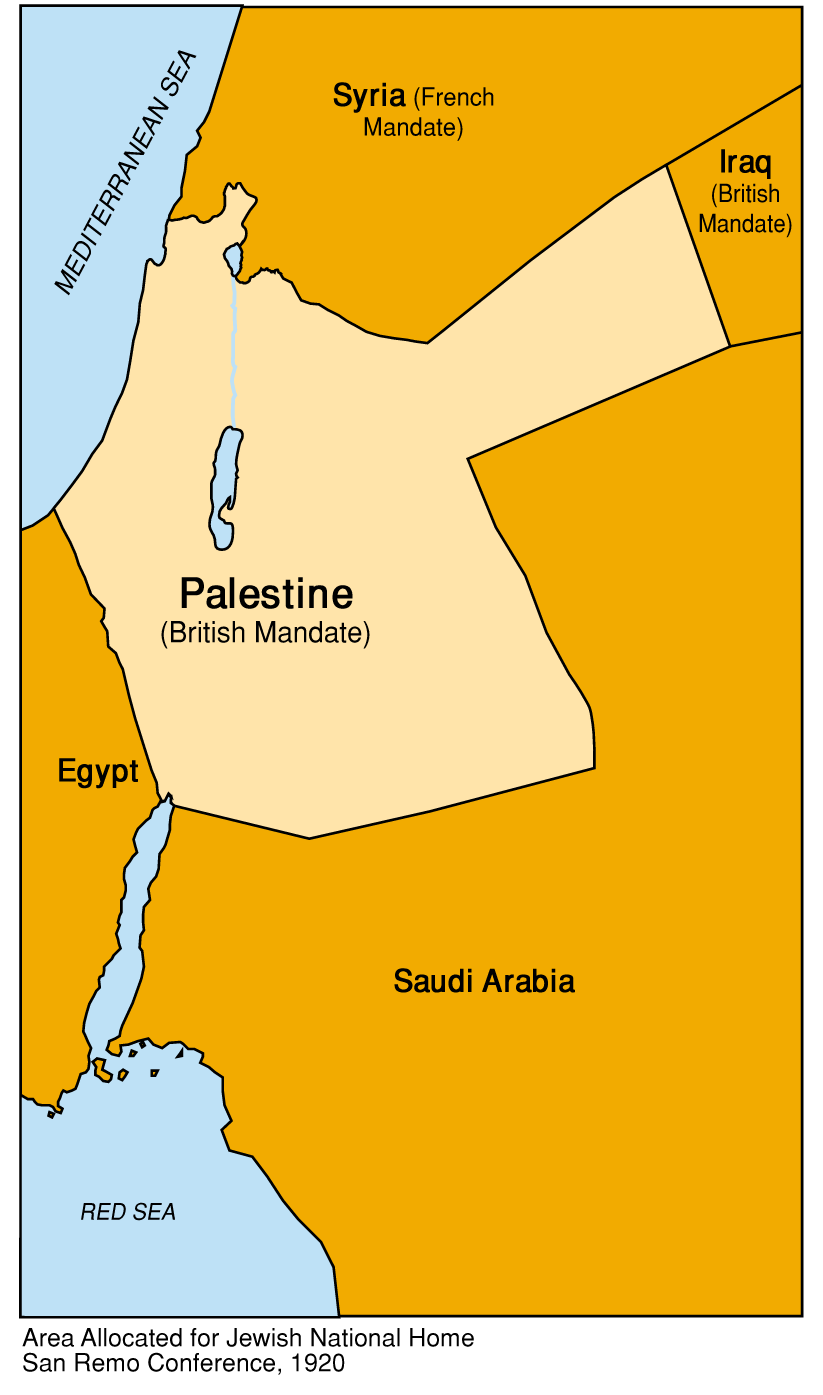
- 1918: At this time, there was no such thing as a state of Israel, nor had there there any administrative district named Palestine nor any Ottoman territory with borders like these. Instead, there was a British Mandate for Palestine. The British did not claim sovereignty but were instead the custodians assigned by the League of Nations to administer the land until sovereignty was established. A better map looks like this: https://www.jewishvirtuallibrary.org/images/mandate1.gif
- 1947: The map here describes the "displacement of Palestinian inhabitants". Ignoring the fact that the term Palestinian was used to describe the Jews at that time, there was no such phenomenon of "displacing Palestinian inhabitants" through 1947; the land transfers were all voluntary purchases. Furthermore, this map confusingly contrasts Jewish settlements with blue colored empty land, as if to suggest that were somehow Arab land. A better map would look like this: https://i.redd.it/1dn46n9vgmw41.png
- 1960: While this is the first map that depicts a sovereign Israel, it conveniently ignores _why_ any Arab inhabitants were displaced: after the UN approved a division of Palestine among Jews and Arabs, the Arabs started a war of annihilation against the Jews, but ultimately lost. Confusingly, this map does not depict the 156,000 Arabs that remained as Israeli citizens (other than perhaps some in the Galilee?).
- 2015: This map oversimplifies the complexities of the Oslo accords, painting Area C as if Israel claimed sovereignty over it (Israel does not), and continues to obscure the ~2 million Arabs living in the state of Israel.
Side note: I'm always curious what people mean when they say "Zionist" here. It would imply that you're not a Zionist, i.e. you don't believe the Jews are entitled to sovereignty. Either you support destroying the state of Israel, or you have a different definition of Zionist I don't understand.
You do realize that most of the West Bank, if not all of it, will be annexed during the Trump administration right? And probably half of Gaza will be annexed as well. It is the end of any two-state solution. Not clear what will happen to the Palestinians there, but it probably won't be great for them.
No, it won't be. Israel doesn't want to grant citizenship to the 3 million Arabs who live there, the vast majority of whom would like to annihilate the state of Israel. There is no plausible path forward for Israel to annex Jenin, Ramallah, Tulkarm, etc., without forcibly expelling the Arabs living there - and that would be wildly unpopular, to say the least.
> No, it won't be. Israel doesn't want to grant citizenship to the 3 million Arabs who live there, the vast majority of whom would like to annihilate the state of Israel
There is a plan for this though. The pressure is building in the West Bank with attempts to cut PA funding/banking and expanding settlements.
I don't see anything in those articles that describe a plan or even the framework of a policy to annex the territories.
There just isn't a workable path forward to accomplish it. The Arabs who live there harbor irredentist fantasies to overthrow the Israeli government and replace it with Hamas or some other dictatorial organ, and as long as that is true, Israel has no desire to hand out citizenship to those people.
Of course, the minute that ideology becomes anathema among Palestinian Arabs, the whole point is moot because Israelis will have their security and a two-state solution would immediately become workable.
> I'm surprised to see such conspiracy theories favored by the likes of Osama Bin Laden and Yasser Arafat like "Greater Israel" trumpeted on Hacker News.
I read about it primarily in the Israeli newspaper Ha'aretz. Here are a few recent articles on the topic, no need to read Osama Bin Laden or Yassar Arafat:
"Trump's Return Is a Victory for Greater Israel, Annexation and Apartheid"
"The wind is at their backs. Activists screaming for a Greater Israel want the government to annex Gaza, Judea, and Samaria. Former U.S. Ambassador to Israel David Friedman has published the manifesto."



At some point the Egypt-Israel relationship could deteriorate and Israel could expand in that direction again.
Overall expansionist/conquest urges are back in with Russia, US under Trump and Israel. We will probably see China also get into the act.