this post seems to mix some valid points and some completely bonkers unrelated things, like the assumption that somehow the US is in stagflation using a graph truncated at data from 2023. Not really explaining why stagflation would cause burnout anyway.
And while I agree with the idea that the society does not pay enough attention to burnout, the article offers no explanation of why he think it's a tsunami, beyond "three people I don't know quit suddenly" (sic).
The article says "everyday life is much harder now, and getting harder". That may be, but there's no proof this is causing more burnout.
One big trigger for burnout is if you cannot answer the question "why do I work?" any more. One of the big whys was that working hard allows you to buy a house/appartment which allows you to maintain your standard of living in retirement. But this isn't true any more due to the declining purchasing power of salaries.
Why should I be stressed out in my job if this only allows me to rent an apartment that i have to give up as soon as I stop working?
I got two kids that will be going to college in about 5 years. My wife and I haves saved as best we could all their lives but it’s still a bill ranging from 250k to maybe a half million dollars coming due on top of all the other bills and retirement savings. For many, “burnout” is just not an option.
As another parent, that sounds like a frightening financial burden :( So, $125k-$250k for each child? Is that the going rate in USA now? for comparison , here in UK its gone up lots but 3 years at university would cost approx £30k in tuition, plus maybe £40k in living costs that could be largely avoided by staying at home and going to college locally. Which can be mostly borrowed, and paid back as an extra 9% in tax on earning above a certain amount after graduation. Even with these figures, my wife and I will still encourage our kids to look hard for decent apprenticeships, consider Open University, possibly work part-time and study part-time, to avoid having such a big debt, especially given cost of housing etc. Kinda wonder whether your figures make it worth going to college at all? 20 years ago I met an American who had 6 figure debt from law school and was doing a job at a law firm that she disliked in order to pay off the huge loan so that after that she could then do what she wanted which would pay much less....
Yeah, if I had kids I'd go back to france for studying costs:
175 euros per bachelor year;
250 euros per Master year;
618 euros per (public) engineering school year* ;
391 euros per Doctorate year...
Cost of life depends on the city but you can get financial help with it if parents are low income, so there is no reason to burn out to pay for tuition there... it has other downsides mind you but education is still solid in 24-25.
Not to be rude, but one divorce could wipe out all that you had saved. Then burnout might be a better option for your kids when it comes time to filling out FAFSA.
I'm knocking on wood. I don't want what happened to me to happen to you.
> The article says "everyday life is much harder now, and getting harder". That may be, but there's no proof this is causing more burnout.
The definition of burnout is a professional ailment caused by work conditions (inappropriate workload, lack of recognition, lack of support). Whatever happens in everyday life is a different problem. You can struggle in life and not be burnt out by work and vice versa.
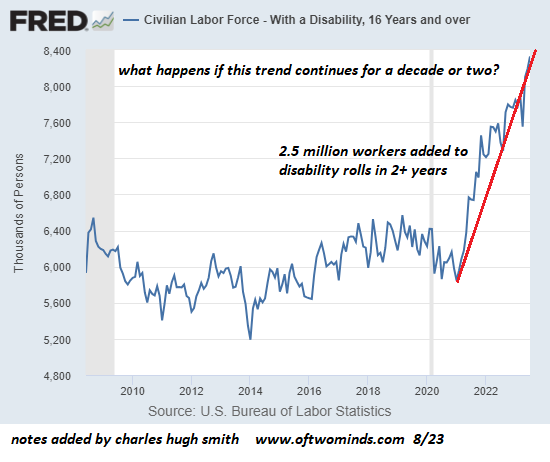
I agree, and I suspect most people are just engaging with the title more than its actual contents. To me this reads as a bit perma-bear/conspiracy theory inspired. The article is lacking in pretty much any evidence to support its claims besides the FRED graph of disability claims.
Also I'm pretty sure that graph is showing almost the opposite of what they're saying it shows. The number of non-participants (of working age) in the US labor force has actually been very static since June 2020, following a sustained jump during early COVID: [0]. The number of participants has been increasing steadily since then: [1].
The graph [2] shows the number of people in the labor force with a disability so combined with graphs 0 and 1 I'm pretty sure it's showing that people with disabilities are participating more in the labor force and/or that more working people are getting diagnosed with conditions (like ADHD) that qualify as disabilities (if I had to guess, likely because of telemedicine taking off in 2020). It does not show non-participation in the labor force due to disability like they imply.
Yeah the stagflation section was so weird that it made me discount the rest of the essay...
You can't demonstrate stagflation with just the inflation time series. That only demonstrates inflation. You need another time series, or a compound metric of some kind, to demonstrate stagnation alongside inflation.
I don't think any period in my working lifetime has been one of stagflation. We have had stagnation without inflation, and inflation without stagnation, but not both at once.


And while I agree with the idea that the society does not pay enough attention to burnout, the article offers no explanation of why he think it's a tsunami, beyond "three people I don't know quit suddenly" (sic).
The article says "everyday life is much harder now, and getting harder". That may be, but there's no proof this is causing more burnout.